


 Brasil
 United States
 United Kingdom
 Australia
 Netherlands
 France
 España
 Italia
 السعودية
7 Best Table Tennis Paddles for Beginners in 2026
Seven lightweight, approved pre-assembled paddles for learning the strokes, with the difference between shakehand and penhold and the mistakes that slow beginners down.
Updated on 2026-10-07
On this page
The most common mistake beginners make is buying the fastest paddle their budget allows. The best table tennis paddle for beginners is the opposite: a lightweight pre-assembled paddle with thin sponge and ITTF-approved rubbers, which keeps the ball slow enough for you to hit the table while you learn the motion.
In the first few months, what makes you improve is repeating the right stroke hundreds of times. A controlled paddle turns more of those repetitions into balls that land on the table, and that speeds up learning more than any carbon blade.
The 7 best table tennis paddles for beginners in 2026
- 1
- Composition
- 5 wood
- Blades
- 5
- Handle
- Concave (FL)
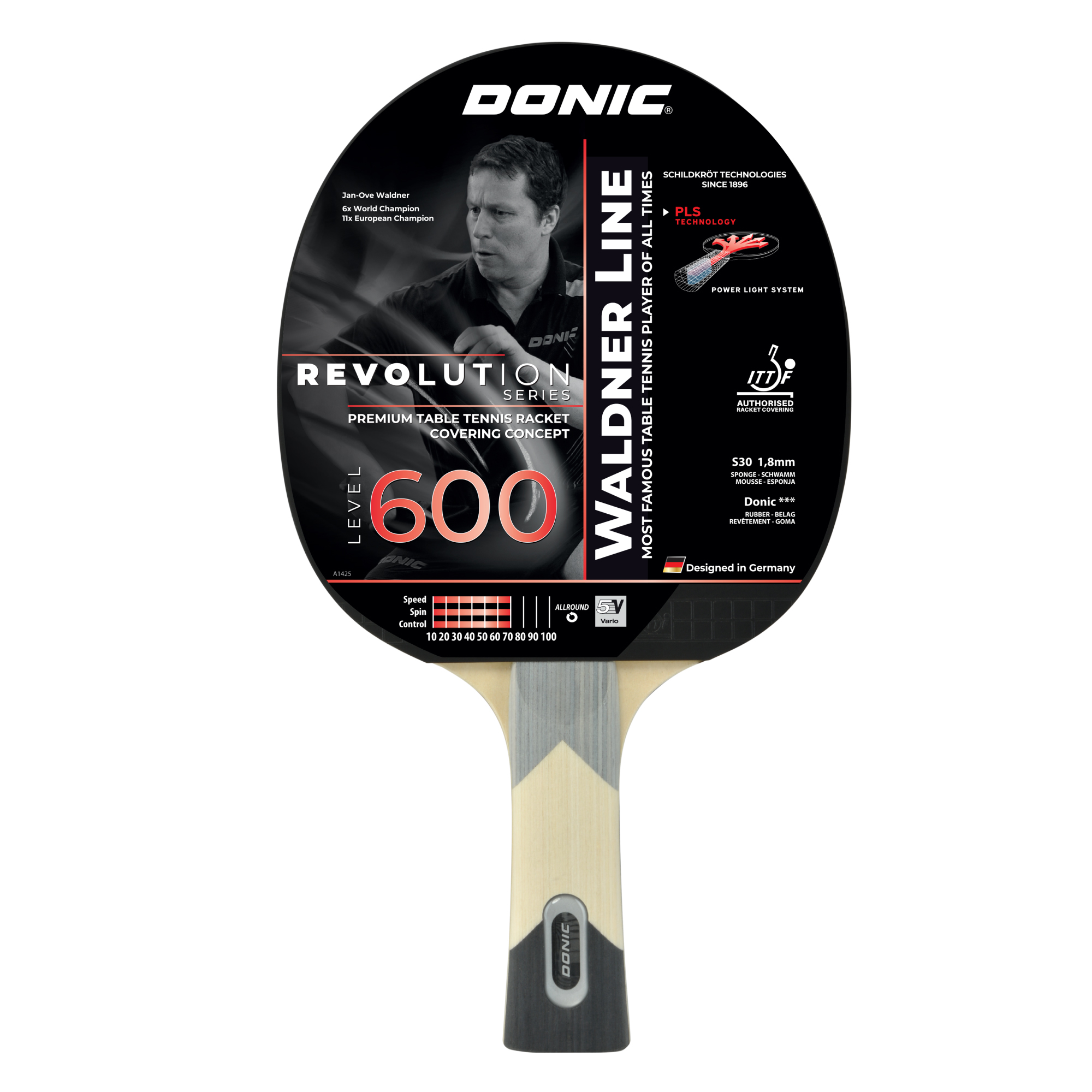
ITTF-approved Donic rubber with 1.8 mm sponge, concave handle, and the Power Light system, which hollows out the handle and moves the weight to the head. About 165 g. Recommended by Donic for beginners and schools.



Why start with a pre-assembled paddle
A pre-assembled paddle, also called factory-assembled, already comes with both rubbers glued to the blade. For beginners, it has three clear advantages:
- It costs less than a blade plus two rubbers bought separately. A decent club setup costs several times the price of an entry-level pre-assembled paddle.
- It already comes balanced. The manufacturer pairs a soft blade with a control rubber, so you don't risk combining a fast blade with a fast rubber.
- You don't know what you like yet. Preferences for harder or softer rubber, straight or concave handle, only show up after a few months of training.
The time to switch to a custom-built paddle comes when you already hit topspin regularly on both sides. The guide to pre-assembled vs. custom-built paddles explains this transition in detail.
Control before speed
Packaging often carries ratings for speed, spin, and control. Each manufacturer uses its own scale, so those ratings are no use for comparing different brands. To choose, the spec sheet tells you more.
What really matters for beginners is the sponge thickness:
| Sponge | How the ball comes off | Who it's for |
|---|---|---|
| 1.5 mm | Slow, low, very predictable | First weeks, kids, people who play at home |
| 1.7 to 1.8 mm | Still controlled, with a bit more speed | Players who already rally regularly |
| 2.0 mm or more | Fast, with more catapult | Players who already attack and train at a club |
The sponge works like a spring between the rubber and the wood. The thicker it is, the more energy it returns, and the more the ball "jumps" off the paddle when you haven't mastered the angle yet. That is why a 1.5 mm sponge paddle, like the Addoy 1000, tends to be easier to control than a 2.0 mm one, even if it feels "weaker" on the first day.
Weight: not too light, not too heavy
An entry-level pre-assembled paddle generally weighs between 150 and 190 g. Below 160 g, like the Vollo Impulse, it is nimble and tires the wrist less in a long session, which helps kids and people who play only occasionally. Near 185 g, like the DHS 1002, it has more inertia: the ball comes off firmer on blocks, but the paddle takes a little longer to get back into position.
For an adult who will train once or twice a week, any value in this range works. If your forearm feels tired at the end of a session, go for the lighter ones.
ITTF approval: what it means and how to check
When a pre-assembled paddle says "ITTF approved," it is the rubbers that have approval, not the whole paddle. The International Table Tennis Federation publishes the list of authorized coverings, and only those rubbers may be used in official tournaments. You can check the list on the ITTF equipment site.
In practice, check three things:
- ITTF logo printed on the rubber, near the handle, next to the model name.
- One side black and the other a bright color. The rules require the two sides to be different colors, one of them black. Red is the most common, and colors such as blue, green, pink, and purple are also accepted on the colored side.
- Rubber with sponge and a grippy surface. Pips-out rubbers without sponge exist and are legal, but they are not what a beginner needs.
For casual play, approval is not required. Even so, it works as a quality seal: approved rubber usually has more consistent grip and sponge than the rubber on toy paddles.
Heads up
Colorful kits with rubbers in two bright colors (blue and yellow, green and purple) are not accepted in tournaments, because neither side is black. They are fine for playing at home, but not for anyone who plans to play at a club or compete.
Grip: shakehand or penhold
Before choosing the model, decide how you will hold the paddle. That determines the type of handle.
Shakehand
It is the most widely used grip today: you hold the handle as if shaking someone's hand, with your index finger resting on the backhand rubber. It gives similar reach on both sides and is what most coaches teach first. All the paddles in the ranking above, except the Nitchugo I, use a shakehand grip.
For beginners, the concave handle (FL) is the best fit. It is wider at the base, which keeps the paddle from slipping out of your hand on a hard stroke. The straight handle (ST) is preferred by players who change hand position a lot, such as defenders, and the anatomic (AN) has a bulge in the middle to fit the palm.
Penhold
You hold the handle like a pen, with your thumb and index finger on the front. There are two styles:
- Japanese penhold: wooden handle with a cork support and, generally, rubber only on the attacking side. It has a strong tradition. The Butterfly Nitchugo I and the Butterfly Biriba II are pre-assembled options for those who want to start in this style.
- Chinese penhold: short handle, rubber on both sides, and using the other face for the backhand (the so-called reverse penhold backhand).
Penhold gives a very loose wrist in the short game and on the forehand, but demands more footwork to cover the backhand side. If you don't have a coach who plays penhold, shakehand is the simplest path.
Kids and families: kit or individual paddle?
People buying their first table for the home usually look at kits with two or four paddles and balls. They make sense when the goal is group fun and nobody plans to train regularly. The JOOLA Family Set, for example, includes four 5-ply paddles with sponge and edge tape, ten balls, and a case that can be attached to the table. It is JOOLA's most-reviewed kit on Amazon, rated 4.5 across more than 6,000 reviews.
For kids around 7 or 8 and up who will take lessons, the recommendation changes: an individual paddle, light and approved, does more for them than a kit paddle. The low weight keeps the wrist from "dropping" at the end of the motion, and the better rubber lets the child feel spin from early on. Models near 150 to 165 g, like the Vollo Impulse and the Donic Waldner 600, work well.
A quick test before you buy
If you can hold the paddle in the store, run three checks in under a minute:
- Grip: hold it in a shakehand grip and make the forehand motion. The handle shouldn't turn in your hand or force you to squeeze.
- Rubber: check that both faces are glued down completely, with no bubbles or loose edges.
- Weight at the tip: hold it only by the handle, with the paddle horizontal. If it "pulls" your wrist down, the head is heavy and will tire you more.
What to avoid in your first paddle
Recreational paddle with bad rubber
Many paddles sold in table kits or toy stores have hard smooth rubber with no grip, or a thin sheet glued directly to the wood. They look the same in the photo, but in the hand the ball slides: your opponent's spin serve comes back high or goes into the net, and you can't spin the ball back. People who train with them end up learning only to push the ball.
The test is simple: run a clean finger across the rubber. Good rubber has slight friction, almost "grabbing" your finger. If it feels like smooth plastic, it is a toy.
Pro paddle
Athlete blades, such as the carbon ALC or ZLC ones, are made for players who already have a complete stroke. In a beginner's hands, they increase the speed of the mistakes. The guide to the best table tennis paddles of 2026 shows where these blades fit and for whom.
Plastic paddle for outdoor use
Polypropylene paddles, like the ones for outdoor use, withstand sun and rain, but they are not approved and don't have the same ball response. They make sense for an outdoor table or a beach club, not for someone who wants to learn technique.
How to care for your paddle so it lasts
An entry-level pre-assembled paddle is not made for rubber changes, so caring for it extends its useful life:
- Store it in a case. Dust and sunlight dry out the rubber. The case also keeps the edge from hitting corners.
- Don't leave it in the car. Heat deforms the sponge and can peel the rubber off.
- Clean it with water or a dedicated cleaner and a soft cloth after playing. Sweat and dust take away grip.
- Use 40+ balls. It is the current plastic ball standard and the one used at clubs.
Where to compare more options
The table tennis catalog lets you filter by beginner level and see current offers. If you are choosing between two brands, the pages for Butterfly, Vollo, and Donic gather each one's entry-level lines. And Find Your Racket suggests models based on your answers about how often you play and your style.
What is the best table tennis paddle for a beginner?
A pre-assembled paddle with sponge between 1.5 and 1.8 mm, weighing between 150 and 175 g, and ITTF-approved rubbers. In our catalog, the Vollo Impulse leads thanks to its combination of low weight, approved rubber, and buyer ratings. For even thinner sponge, the Butterfly Addoy 1000 has 1.5 mm.
Should a beginner use a shakehand or penhold grip?
Shakehand is the simplest to learn and the most taught in youth programs, because it covers both sides with the same reach. The Japanese penhold has a long tradition and works very well on the forehand and in the short game, but it demands more footwork. Choose shakehand unless you have a penhold coach.
1.5 mm or 2.0 mm sponge to start?
For the first few weeks, 1.5 to 1.8 mm. Thinner sponge keeps the ball slower and lower, which forgives angle mistakes. 2.0 mm starts to make sense when you already rally regularly and begin to attack.
Can I play in a tournament with a pre-assembled paddle?
Yes, as long as the rubbers are on the ITTF's authorized coverings list, carry the federation's logo, and one side is black. Several entry-level paddles in the catalog, such as the Vollo Impulse and the Donic Waldner 600, meet these requirements.
How long does a beginner paddle last?
It depends on how often you play. Playing once or twice a week and storing the paddle in a case, the rubber usually keeps good grip for many months. When it feels smooth to the touch and the ball starts to slide on serves, it is time to replace the paddle or move to a custom-built one.
Is a heavier paddle better?
Not necessarily. A heavier paddle gives more stability on blocks, but tires the wrist and takes longer to get back into position. For beginners and kids, the lighter ones in the range, around 150 to 165 g, usually work better.
Where to buy the racquets in this guide
- Waldner 600 Donic5 wood · 5 · Concave (FL)See priceTenniszon
The prices above are checked automatically at each store and may have changed since the last check. The price that counts is the one shown on the store's website at checkout. We may earn a commission on purchases made through store links, at no extra cost to you.