


 Brasil
 Canada
 United Kingdom
 Australia
 Netherlands
 France
 España
 Italia
 السعودية
7 Best Racquetball Racquets for Beginners in 2026
Why beginner racquetball players need a heavier racquet, which grip to use, how the sport differs from squash and the 7 best racquets to start with.
Updated on 10/07/2026
On this page
- 1.What racquetball is, in a few lines
- 2.Racquetball vs. squash: not the same sport
- 3.Why beginners need a heavier racquet
- 4.The 7 best racquetball racquets for beginners
- 5.Highlights for each type of beginner
- 6.Comparison of the beginner models
- 7.Aluminum, composite or graphite?
- 8.What else the beginner needs to buy
- 9.Common mistakes when buying a first racquet
- 10.Care that makes your first racquet last
- 11.How to know it is time to switch racquets
- 12.Frequently asked questions
- 13.Verdict
Anyone starting racquetball should look for a racquet that is heavier than they expect, between 185 and 205 g unstrung, with a large head (107 or 108 sq in) and a small grip. This combination makes up for a still-short swing and for off-center hits, which are normal in the first few months. Below are the best racquetball racquets for beginners in our catalog, with the technical reasoning for each one and the differences from squash, which confuse a lot of people.
What racquetball is, in a few lines
Racquetball is played on an enclosed four-wall court, with the ceiling also in play. The official court is 40 feet long, 20 wide and 20 high, or about 12.2 x 6.1 x 6.1 m. The ball is hollow, made of rubber, about 57 mm in diameter and very lively: it comes back fast and high, and the rally is intense from day one.
The central rule is simple: after each shot, the ball has to hit the front wall before bouncing on the floor. On the way it can hit the side walls, the ceiling and the back wall. You can let the ball bounce once on the floor before returning it, or return it on the fly. The point ends when someone cannot do that.
The game came about in the United States around 1950 and today the reference rules are those of USA Racquetball and the International Racquetball Federation (IRF).
Racquetball vs. squash: not the same sport
The confusion is common because both use an enclosed court and a front wall. But a squash racquet does not work for racquetball, and the reverse is also true.
| Racquetball | Squash | |
|---|---|---|
| Racquet | Short, up to 22 in (55.9 cm), large head | Long, up to 68.6 cm, smaller head |
| Ball | Hollow, about 57 mm, bounces a lot, comes off lively right away | About 40 mm, bounces little, needs to be warmed up |
| Court | About 12.2 x 6.1 m, ceiling is in play | About 9.75 x 6.4 m, with out lines and a tin strip at the bottom |
| Typical shot | Short, wrist-driven, low ball to the front wall | Longer swing, slower point construction |
| Protection | Eyewear mandatory in competition, wrist cord on the racquet | Eyewear recommended (mandatory for juniors in many competitions) |
For someone coming from squash, the biggest surprise is the speed of the ball and the fact that almost nothing goes out of the court. For someone coming from tennis, it is the size of the racquet and how much the wrist works.
Why beginners need a heavier racquet
In tennis and padel the rule is usually "light to start." In racquetball it is the opposite, and the reason is physical.
- A short swing generates little speed. The power of the stroke comes from mass times head speed. Someone who is learning does not yet accelerate the racquet well; a 190 to 200 g racquet makes up with mass for what is missing in speed.
- An off-center hit twists the racquet. A ball that hits near the frame makes the head rotate in the hand. The more mass, the less it rotates, and the ball still reaches the front wall.
- The ball comes hard. Even in beginner play, the ball comes back off the wall with a lot of energy. A racquet that is too light "closes" or "opens" on impact.
Racquets of 155 to 165 g exist and are excellent, but for players who already have a fast, technical swing. We detail this transition in the guide to racquets for intermediate players.
Head-heavy balance: it helps, but it is not everything
Weight shifted toward the head increases the energy at impact, which makes life easier for players with a short swing. That is why many starter and club racquets pull the balance toward the tip; the Gearbox GB-125, for example, has 10 mm toward the head.
But not every manufacturer publishes the balance, and some heavy entry racquets do the opposite. The HEAD MX Fire is 190 g with a balance of 270 mm, slightly handle-heavy, so the high weight does not tire the arm. For the beginner, the order of priority is: total weight first, head area second, balance third.
Large head and small grip
A head of 107 or 108 sq in enlarges the usable area of the stringbed. Shape matters: the Quadraform (a squarer head) has a more central sweet spot and forgives more than the teardrop.
A small grip may seem strange, but it is the standard in the sport. The most common sizes are 3 5/8 inches (about 92 mm in circumference) and 3 7/8 (about 98 mm). A thin grip lets the wrist release at the end of the stroke, which is where the power comes from in racquetball. When in doubt between two sizes, go with the smaller one: you can thicken it with an overgrip, but you cannot make it thinner.
The 7 best racquetball racquets for beginners
7 best racquetball racquets for beginners in 2026
- 1
 Most reviewedGB-50 Gearbox
- Weight
- 190 g
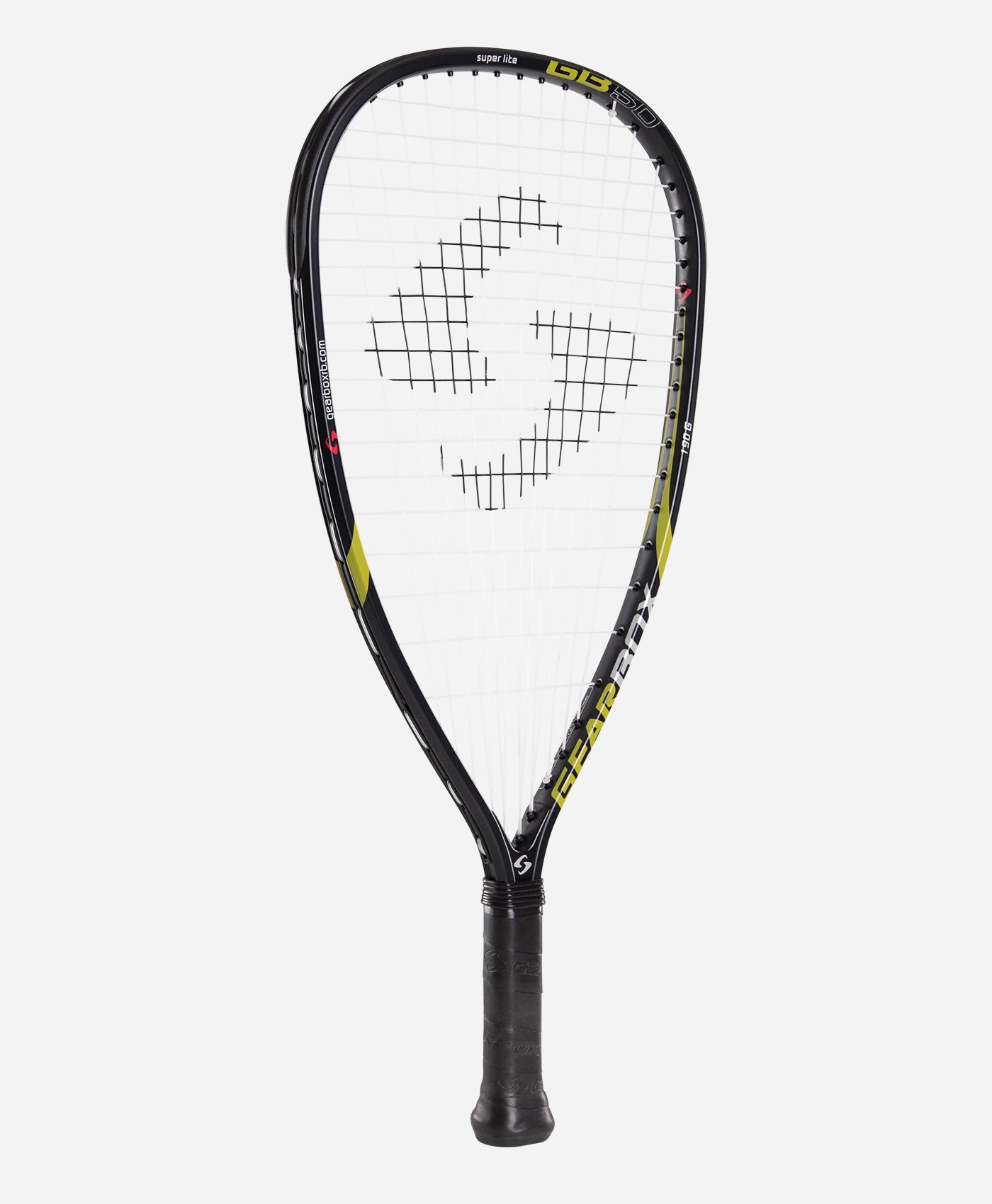
7000-series aircraft aluminum, 190 g unstrung and a hybrid head between teardrop and Quadraform. Comes already strung, with a 3 5/8-inch grip. Rated 4.3 out of 5 across 164 Amazon reviews, and the aluminum tends to hold up well to the first months of wall hits.

Highlights for each type of beginner
Will play once in a while: Gearbox GB-50 or HEAD MX Fire
Aluminum is heavier for the same performance and transmits more vibration than graphite. In return, it can hit the side wall, the floor and the ceiling without cracking, which happens a lot at the start. The GB-50 has the advantage of the hybrid shape and of having an offer and buyer reviews recorded in the catalog; the MX Fire is the rental-racquet reference from HEAD.
Strengths
- + 7000-series aluminum withstands hits on the wall and floor
- + 190 g gives stability to players who still have a short swing
- + Hybrid head between teardrop and Quadraform
- + Comes already strung and with a 3 5/8-inch grip
Drawbacks
- − Aluminum transmits more vibration than graphite
- − Becomes limiting when the player starts to accelerate the stroke
Want to improve fast: E-Force Chaos or Exile
Both E-Force racquets are over 195 g and have LongString, in which the center strings run through the hollow handle. A longer string tends to deflect more on impact. The difference is the shape: the Chaos is Quadraform and the Exile is teardrop. As a general rule, the Quadraform forgives more and the teardrop favors those who hit the top of the head. If you miss the center a lot, start with the Chaos.
Have elbow pain or are starting after 40: HEAD Innegra Laser
Comfort comes from two sources: a material that absorbs vibration and enough weight so the racquet does not shake. The Innegra Laser combines both: it is 185 g and uses Innegra fiber, which HEAD employs to absorb impact. The 265 mm balance, toward the hand, makes the racquet easier to maneuver. If the pain persists, see a health professional before blaming only the equipment.
Comparison of the beginner models
The racquetball comparison tool lets you put any other model in this table.
Aluminum, composite or graphite?
| Material | How it behaves | Who it is for |
|---|---|---|
| Aluminum or alloy (GB-50, MX Fire, MX Cyclone) | Heavy, durable, more vibration, little response | First weeks, occasional play, backup racquet |
| Graphite with fiberglass (GB-75, GB-125) | Lighter and more responsive, still durable | Those who play every week and want to improve |
| Graphite and carbon (Chaos, Exile, Breakout) | Stiff, powerful, better feel | Committed beginner who does not want to switch soon |
Fiberglass makes the frame a little more flexible and less responsive than pure graphite, but it lowers cost and increases resistance to knocks. It is a good step between aluminum and performance racquets.
What else the beginner needs to buy
Heads up
Protective eyewear is not optional. The racquetball comes off the wall at high speed and, on an enclosed court, the players are close to each other. In USA Racquetball competitions all players must wear lensed eyewear made for racquet sports that meets the ASTM F803 standard. Wear it in casual play too: regular glasses or sunglasses do not protect and can break on impact.
- Wrist cord: every racquetball racquet has a cord attached to the handle. Always attach it to your wrist; it is required by the rules and keeps the racquet from flying toward your opponent.
- Glove: very common in the sport. The handle is thin and sweat makes the racquet turn in your hand. It is not mandatory, but it helps.
- Indoor court shoes: non-marking sole with good lateral support. Running shoes leave the ankle exposed on changes of direction.
- Balls: buy a can; they lose liveliness with use and can burst.
Common mistakes when buying a first racquet
- Buying for the pro look. The racquets that appear in tournament videos are 155 to 170 g and were made for players who already generate a lot of speed. In the hands of a beginner, they become a weak, unstable racquet.
- Using the squash or tennis racquet you already have at home. Besides exceeding the 22-inch limit, it is too long for the space of the court and increases the risk of hitting your partner.
- Choosing a big grip "to hold better." The thin grip is what lets the wrist work. If the racquet slips, the solution is a glove or overgrip, not a thicker handle.
- Leaving the eyewear for later. The very first game already has a fast ball a few feet from your face.
Care that makes your first racquet last
A beginner's racquet takes a beating. A few simple precautions avoid replacements before their time:
- Bumper guard: the rubber at the top of the head absorbs hits on the floor and the wall. When it cracks or comes loose, replace it; an exposed frame chips quickly.
- Grip: when the original grip gets slick and shiny, replace it or cover it with an overgrip. A worn grip makes you squeeze the handle harder and tires the forearm.
- Heat: do not leave the racquet in the trunk in the sun. Excessive heat affects string tension and can damage the frame.
- Strings: a string that has broken cannot be mended. On an entry aluminum racquet, restringing usually pays off; check whether anyone near you strings racquetball racquets.
How to know it is time to switch racquets
A beginner's racquet does its job until you start to feel that it slows you down. The signs are clear: you already hit the center often, want to hit the ball lower on the front wall and notice the racquet arrives late in fast rallies. That is when it is worth dropping to the 170 to 180 g range.
If you are still deciding whether to stay with the sport, the guide racquetball: how to start and which racquet to buy shows the progression of equipment by stage. To understand each specification in detail, read how to choose a racquetball racquet. And Find your racquet does the selection from your profile.
Frequently asked questions
What is the best racquetball racquet for a beginner?
For someone who plays once in a while, the Gearbox GB-50: durable aluminum, 190 g and a hybrid head. For someone who wants to improve fast, the E-Force Chaos, which is 205 g with a 107 sq in Quadraform head.
Can I play racquetball with a squash racquet?
No. A squash racquet is longer, has a smaller head and was made for a smaller, slower ball. It also exceeds the 22-inch limit in the racquetball rules. The reverse does not work either: a racquetball racquet is too short for squash.
What is the ideal racquetball racquet weight for a beginner?
Between 185 and 205 g unstrung. The mass makes up for the short swing and stabilizes the racquet when the ball hits off-center. Racquets under 170 g make more sense once your stroke is already formed.
What grip size should I choose?
The most common are 3 5/8 and 3 7/8 inches. A racquetball grip is thin on purpose, so the wrist can release on the stroke. When in doubt, choose the smaller one and thicken it with an overgrip if you need to.
Do I really need to wear eyewear to play racquetball?
Yes. In official competitions it is mandatory to wear protective eyewear for racquet sports that meets the ASTM F803 standard. In casual play the ball has the same speed, so the risk is the same.
Is an aluminum racquet bad?
Not for starting out. It is heavier and vibrates more than graphite, but it takes hits on the wall and floor, which are common in the first months. It becomes a limitation when the player starts to generate swing speed and wants more response.
Verdict
Where to buy the racquets in this guide
- GB-50 Gearbox190 gSee priceAmazon
The prices above are checked automatically at each store and may have changed since the last check. The price that counts is the one shown on the store's website at checkout. We may earn a commission on purchases made through store links, at no extra cost to you.