


 Brasil
 United States
 United Kingdom
 Australia
 Netherlands
 France
 España
 Italia
 السعودية
Badminton racket weight and grip: 3U, 4U, 5U and G4, G5, G6
How to read the U and G codes on a badminton racket, what changes between 3U, 4U and 5U, how to test the grip and why maximum tension changes with weight.
Updated on 2026-10-07
On this page
- 1.Reference table: how to read U and G
- 2.Where the code appears and how to decode it
- 3.The label weight is not the weight in your hand
- 4.Same racket, different weights: the maximum tension changes
- 5.3U, 4U and 5U in the same racket family
- 6.Grip: G4, G5 or G6 in practice
- 7.Signs that the weight or grip is wrong
- 8.Quick decision tree
- 9.Myths and facts about weight and grip
On a badminton racket's weight and grip, the number before the U indicates the weight class (the bigger the number, the lighter) and the number after the G indicates the handle thickness (the bigger the number, the thinner). A "4UG5" label means a racket of 80 to 84.9 g unstrung with a G5 handle, the most common combination on the market. This guide shows how to read these codes, what they don't tell you and how to know whether the size is right for you.
Reference table: how to read U and G
| Code | What it indicates | Range | Practical note |
|---|---|---|---|
| 2U | Unstrung weight | 90 to 94.9 g | Rare today; the Carlton Vapour Trail 90S is an example |
| 3U | Unstrung weight | 85 to 89.9 g | Yonex lists an average of 88 g |
| 4U | Unstrung weight | 80 to 84.9 g | Average of 83 g at Yonex; the current standard |
| 5U | Unstrung weight | 75 to 79.9 g | Average of 78 g at Yonex |
| 6U | Unstrung weight | 70 to 74.9 g | Ultralights, still uncommon |
| G4 | Handle thickness | Thickest | Common on entry-level rackets and in 3U |
| G5 | Handle thickness | Intermediate | The most common of all |
| G6 | Handle thickness | Thinnest | Frequent on Li-Ning and in 5U versions |
In the Racquet Rank badminton catalog, 130 rackets list a 4U class, 35 are 5U, 29 are 3U and only 2 are 2U. On the handle, G5 dominates: 138 rackets, against 21 in G6 and 18 in G4. In other words: if you don't know what to choose, 4UG5 is the statistical starting point.
The guide to how to choose a badminton racket summarizes what each class changes in play. Here we go beyond the table: what the code doesn't say, how it appears on the label and how to test.
Where the code appears and how to decode it
Yonex usually prints the code on the racket itself, near the handle or the shaft, and on the packaging label, in the format "4U5" or "4UG5". The first number with U is the weight; the final number is the grip. Other brands follow the same logic with small variations:
- Look for the number + U combination. "3U", "4U" and "5U" are universal across Yonex, Victor, Li-Ning, Apacs and most brands.
- Then look for the G. If only "4U5" appears, the 5 is the G5 grip.
- Be wary of proprietary codes. Li-Ning uses its own nomenclature on some models, with letters like W for weight and S for handle, and there is no single official conversion table to Yonex's G. When in doubt, check the weight in grams on the spec sheet.
- Read the tolerance. Serious spec sheets list the weight with a margin, like the 88 g ±3 of the Yonex Duora 88 or the 85 g ±4 of the DHS Reflex RF588. Two rackets of the same model can differ by a few grams.
- Read the tension range alongside. Many rackets also have the recommended tension engraved on them, and it can change with the weight class, as we'll see below.
The label weight is not the weight in your hand
The U class is the weight of the frame unstrung and without an extra grip. When the racket arrives ready to play, the string, the factory grip and any overgrip add a few grams. That has two consequences:
- Comparing strung rackets with unstrung spec sheets leads to errors. If you weigh your racket on a kitchen scale, it will go over the class limit, and that is normal.
- What you add to the handle changes the balance. An overgrip makes the racket heavier at the handle and therefore a little lighter at the head. A towel grip thickens and weighs even more. The effect of balance on play is in the guide to balance and flex.
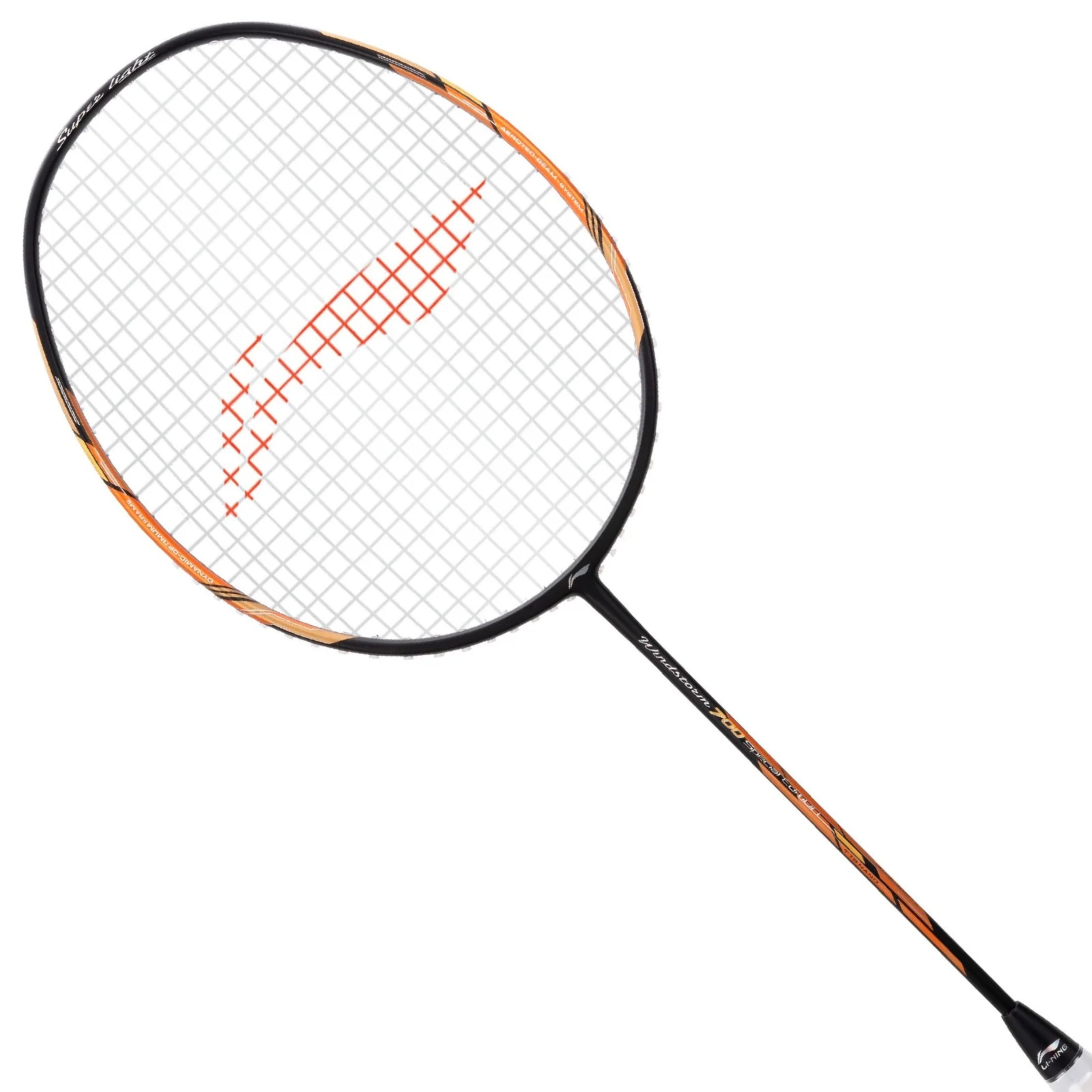
Another detail: within the same class, the weight distribution can be opposite. The Yonex Astrox Lite 27i and the Li-Ning G-Force Superlite 5900 are 5U, light and head-heavy. The Li-Ning Windstorm 700 Special Edition is also 5U (79 g), but with an even balance. The U tells you how much it weighs, not where the weight is.
Same racket, different weights: the maximum tension changes
Many models come in more than one class. On Yonex spec sheets, it is common to see the recommended tension change along with it: models like the Astrox 99 Pro and the Astrox 100 Game list 20 to 28 lbs in the 4U version and 21 to 29 lbs in the 3U. On models with a 5U version, the range usually drops another pound, like the 19 to 27 lbs of the Nanoflare 700 in 5U.
The logic is simple: the lighter version has less material in the frame, and the manufacturer gives less margin for high tension. In practice:
- If you buy the lighter version of a model, check the range for that version, not the one for the "main" advertised version.
- Weight class alone doesn't define maximum tension across brands. In the catalog, the Apacs Nano 900 Power is 4U and accepts up to 38 lbs; the Yonex Astrox Lite 27i is 5U and goes up to 30 lbs; the Yonex Arcsaber Lite is 4U and stops at 24 lbs. Construction and line matter more than the U.
The tension ranges by playing level are in the guide to how to choose. The point here is the ceiling: going over the spec sheet's limit can deform or crack the frame.
3U, 4U and 5U in the same racket family
To feel the weight difference in isolation, the ideal would be to compare the same model in all three classes. Since spec sheets rarely separate versions, the comparison below uses three even-balance, 675 mm Yonex rackets, one in each class. Notice that the shaft also changes, from stiff to flexible, which follows the idea behind each one: the heaviest for players with a swing, the lightest for those who need help.
What to expect on the court:
- 3U (Duora 88, 88 g ±3): more stable on drives and blocks against a hard shuttle, a smash with more mass. It demands more on recovery and late in long matches.
- 4U (Arcsaber 11 Play, 83 g average): the middle ground that suits most players, in singles and doubles.
- 5U (Arcsaber 71 Light): reacts faster and tires the arm less, but can "give" when the opponent hits hard at your body.
Grip: G4, G5 or G6 in practice
The G measures handle thickness, and each brand has its own table. A Yonex G5 and another brand's G5 can feel different, which is why the millimeter values circulating online rarely match each other. What counts is the test in your hand.
Examples of G4 and G6 handles available from stores
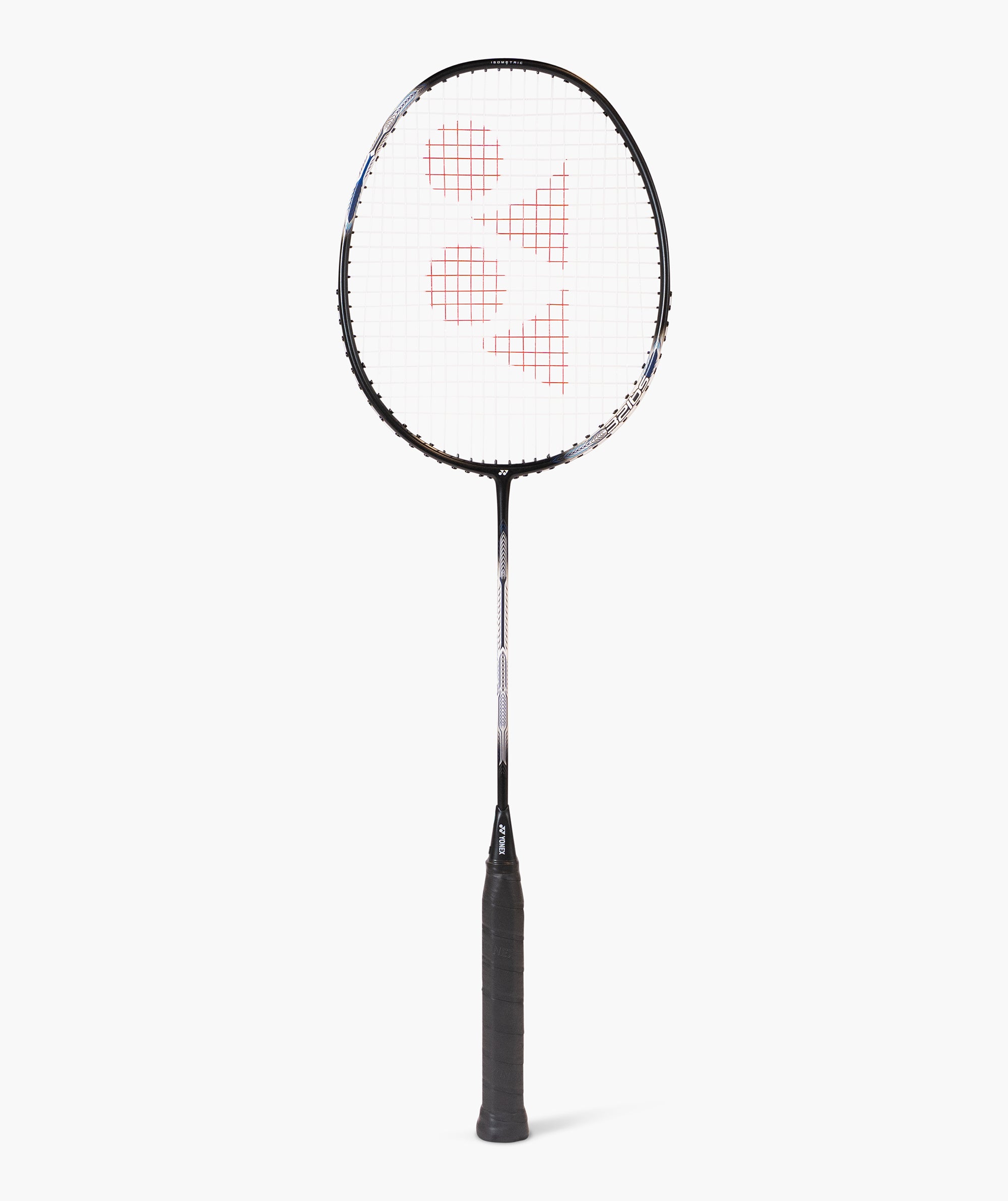




 · Badminton
Windstorm 700 Special Edition Li-Ning
- Weight class
- 5U
- Balance point
- Even balance
- Flexibility
- Flexible
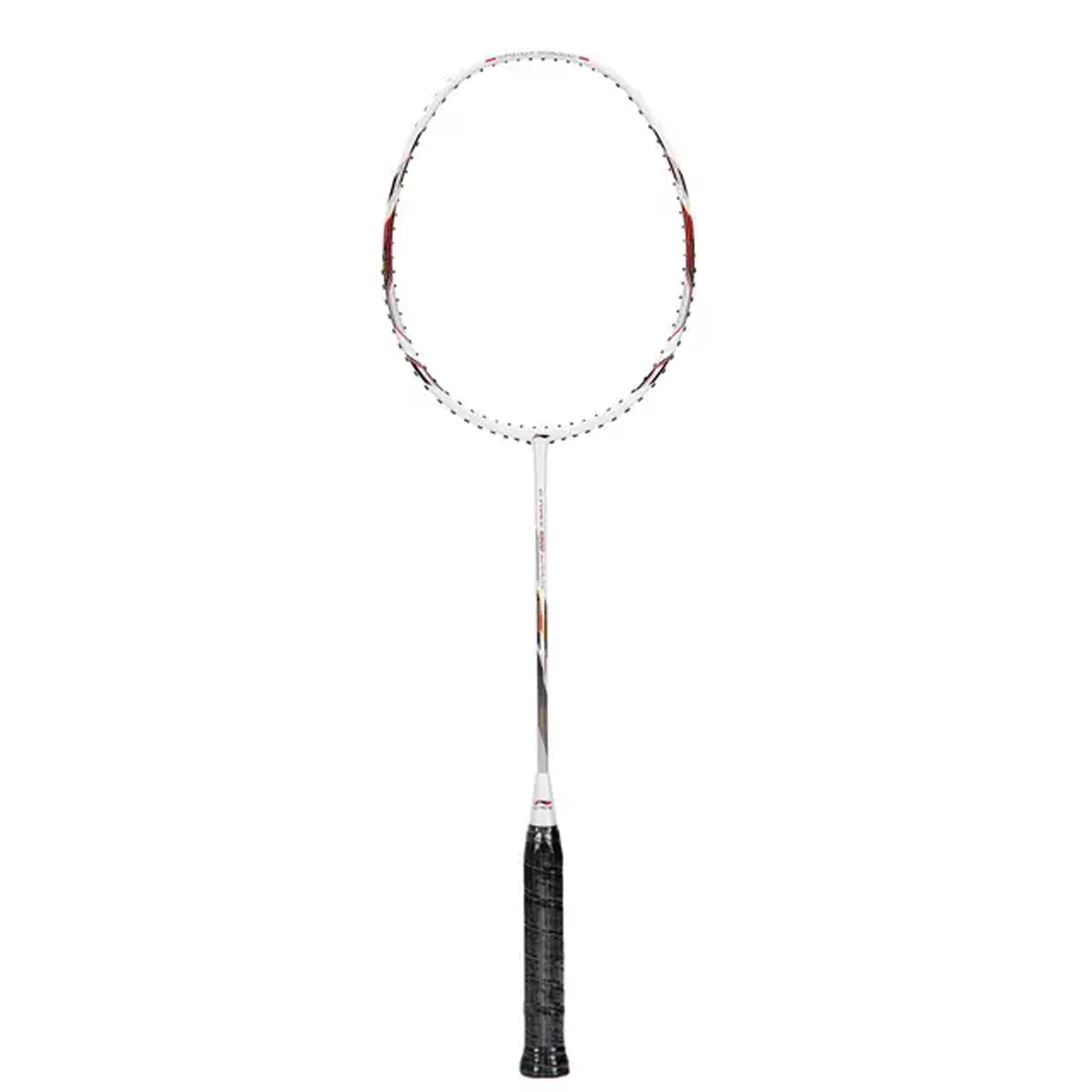
· Badminton
G-Force Superlite 5900 Li-Ning
- Weight class
- 5U
- Balance point
- More head weight
- Flexibility
- Flexible
How to test the grip in 4 steps
- Hold it in the forehand grip, with a relaxed hand, as if you were shaking someone's hand, without squeezing.
- Look at your fingertips. They should wrap around the handle and lightly touch the base of your palm. If there's a lot of space between your fingers and palm, the handle is thick. If your fingers overlap the palm a lot, it's thin.
- Switch to the backhand and back, ten times in a row, fast. The right handle rotates in your hand without you needing to open your fingers. If it catches, it's too thick.
- Make an imaginary drive and block. On impact, the racket can't rotate in your hand. If it rotates with little force, the handle is thin or slippery.
Why a thin handle is usually the best bet
Badminton is a sport of constant grip changes: forehand, backhand, the thumb grip for backhand defense, a short grip at the net. A thinner handle makes all of them easier and gives more finger touch. That is why G5 and G6 dominate the catalog.
Besides, building up is easy: an overgrip adds a little thickness, and a towel grip thickens much more. Thinning a thick handle is not as simple. If you're between two sizes, buy the thinner one and adjust with an overgrip.
Signs that the weight or grip is wrong
| What happens in play | Likely cause | What to try |
|---|---|---|
| Late on defending a smash at the body | Racket too heavy for you, or too head-heavy | A 4U or 5U version, or a more even balance |
| The racket "gives" and the block comes out short | Racket too light for your opponent's pace | Move up from 5U to 4U |
| Clear dies mid-court even with good technique | Lacks mass or the shaft is too stiff for your swing | A 4U with a medium shaft before changing the weight |
| Forearm tires and you grip the handle all the time | Handle too thin or slippery | A new overgrip, or a thicker size |
| Grip changes catch and your hand opens | Handle too thick | Remove the overgrip or go down to G5/G6 |
| The racket rotates in your hand on off-center hits | Thin handle or worn grip | Replace the grip before replacing the racket |
If you have pain in your wrist, elbow or shoulder, adjusting equipment may help with comfort, but it is no substitute for an evaluation. See a health professional.
Quick decision tree
- Just starting or have little arm strength? 4U or 5U, G5 grip. See the rackets for beginners.
- Play more doubles and stay at the net? You can go 5U.
- Play singles or want a smash with more weight? Stay with the 4U.
- Play regularly and already have a full swing? 4U, G5 grip.
- Play offensive singles, have a strong arm and like a stable racket? Consider 3U. The list of attacking badminton rackets has several.
- Play fast doubles? A head-light 4U or a 5U. See the lightweight rackets for doubles.
- Small hand or change grips a lot? G6, or G5 without an overgrip.
- Big hand or heavy sweat? G5 with an overgrip or towel grip; G4 only if you still lack volume.
Myths and facts about weight and grip
- "The lighter, the better." Myth. The lightest racket reacts faster, but it has less mass to stabilize the block and give weight to the smash. 4U is the standard for a reason.
- "G4 is bigger than G5, so it's for adults." Half true. G4 is thicker, but adults use G5 and G6 without a problem. Hand size and preference count more than age.
- "A 5U racket can't take high tension." Depends on the racket. The Astrox Lite 27i and the G-Force Superlite 5900 are 5U and accept up to 30 lbs. What counts is the spec sheet range for that version.
- "The label weight is the weight I'll feel." Myth. The class is unstrung, and balance changes the feel as much as the grams do.
- "An overgrip doesn't change anything in the weight." It changes little, but at the handle, and that shifts the balance downward.
What does 4U mean on a badminton racket?
4U is the racket's unstrung weight class: 80 to 84.9 g. Yonex lists an average of 83 g for its 4U rackets. The bigger the number before the U, the lighter the racket: 3U is heavier and 5U is lighter.
What does G5 mean on a badminton racket?
G5 is the handle size. The bigger the number after the G, the thinner the handle: G4 is thicker, G6 is thinner. G5 is the most common size and suits most adults, with an overgrip if you need more volume.
What is the best badminton racket weight for a beginner?
4U for most, or 5U for those with little arm strength or who play more doubles at the net. The 3U usually tires players who don't have the technique yet.
G4 or G5: which should I choose?
If in doubt, G5. It is easier to build up a thin handle with an overgrip than to thin a thick handle. G4 makes sense for big hands that find G5 too thin even with an overgrip.
Are 4UG5 and 4U5 the same thing?
Yes. It is the abbreviated form that Yonex and other brands use: weight class 4U with a G5 handle.
Does the 3U version take more tension than the 4U?
On many Yonex models, yes, one pound more: 21 to 29 lbs in 3U against 20 to 28 lbs in 4U, as on the Astrox 99 Pro and Astrox 100 Game spec sheets. Always check the range for the version you bought.
To find rackets by weight and handle, use the filters in the badminton catalog, compare up to six models in the badminton comparison tool or let Find Your Racket suggest based on your game. The scoring criteria are in the methodology.
Where to buy the racquets in this guide
- Astrox Attack 9 Yonex4U · FlexibleSee priceAmazon
- Windstorm 700 Special Edition Li-Ning5U · Even balance · FlexibleSee priceAmazon
- G-Force Superlite 5900 Li-Ning5U · More head weight · FlexibleSee priceAmazon
The prices above are checked automatically at each store and may have changed since the last check. The price that counts is the one shown on the store's website at checkout. We may earn a commission on purchases made through store links, at no extra cost to you.