


 Brasil
 United States
 United Kingdom
 Australia
 Netherlands
 France
 España
 Italia
 السعودية
10 Best Squash Racquets for Intermediate Players in 2026
Outgrown your entry-level racquet? See how balance, string pattern, and stiffness change your game, and the 10 squash racquets that make sense for the next step.
Updated on 2026-10-07
On this page
- 1.When you stop being a beginner in squash
- 2.Balance: why intermediate players should move away from a heavy head
- 3.String pattern: 12x17, 14x18, or 16x19
- 4.Stiffness: what changes and why almost nobody publishes it
- 5.The 10 best squash racquets for intermediate players
- 6.Comparison of the intermediate racquets
- 7.Y-Tec Pro or Tour-Tec Pro: teardrop or classic head?
- 8.When to move to a lighter, control-oriented racquet
- 9.Thin frame: what the Head Speed 120 SB changes
- 10.A word on the Dunlop FX 115
- 11.How to test before switching racquets
- 12.String and tension: the adjustment intermediate players tend to forget
The intermediate squash player already hits the center of the strings often and no longer needs the racquet to generate power for them. What they need now is a racquet that obeys: even or head-light balance, a string pattern that holds the ball long enough to aim, and a weight that doesn't make volleys late. In this selection of the best squash racquets for intermediate players, the Unsquashable Y-Tec Pro 125 is the safest choice for the transition, and the others cover players who want more speed, more control, or more stability.
When you stop being a beginner in squash
There is no formal test, but a few signs are clear:
- You sustain long straight-drive rallies down the wall without the ball drifting to the middle of the court.
- You use the boast and the drop on purpose, not by accident.
- You start volleying at the T instead of letting every ball go past to the back.
- The head-heavy racquet that helped at the start now feels slow on fast balls, and the ball comes off long on short touches.
If three of these items describe your game, your entry-level racquet is probably holding back your progress. If not yet, the guide to squash racquets for beginners is the better fit.
Balance: why intermediate players should move away from a heavy head
Balance is the point, measured from the bottom of the handle, at which the racquet balances. On a racquet of about 68.5 cm, around 350 mm is practically the middle, that is, an even balance. Tecnifibre publishes its figures: 350 mm on the Carboflex 125 and 355 mm on the Carboflex 130, both even.
For beginners, mass in the head compensates for a short swing. For intermediate players, it starts to charge a price:
- Volley at the T: the ball comes fast and you have a very short motion. A heavy head is slow to arrive.
- A ball coming back off the side wall: demands a last-second wrist adjustment. The lighter the head, the easier it is to correct.
- Drop shot: the short touch asks the racquet to stop when you want it to. Mass at the top tends to keep the motion going and lengthen the ball.
Even balance keeps a little momentum for the drive from the back; head-light balance (toward the handle) prioritizes reaction. If you play more up front and at the volley, go head-light. If you still spend a good part of the match defending at the back, even balance is more balanced.
Good to know
Weight and balance need to be read together. The Dunlop Sonic Core Ultimate 132 weighs 132 g with a head-light balance, so the mass sits near the hand. The Dunlop CX Team 132 has the same weight with a head-heavy balance, which usually gives more momentum and less agility.
String pattern: 12x17, 14x18, or 16x19
The pattern indicates how many main (vertical) and cross (horizontal) strings the racquet has. In squash, you find three main groups:
| Pattern | Catalog examples | Effect on the ball |
|---|---|---|
| 12x17 (open) | Head Speed and Extreme | More widely spaced strings, more rebound and more "bite" on the ball; wears the string faster |
| 14x18 (standard) | Carboflex, Slash, Unsquashable, FX 115 | Middle ground between power and control; the most common |
| 14x19 and 16x19 (dense) | FX 128 Pro, CX 132, Sonic Core Ultimate 132 | More strings touching the ball, more predictable trajectory, less free power |
For intermediate players, 14x18 is the natural starting point. 16x19 makes sense for players who already have a loose swing and complain that the ball "flies" on touches. 12x17 is for those who want power and spin and accept restringing more often.
Some Head racquets use the Adaptive Fan Pattern, which lets you choose at stringing time between straight strings (more power) and a fan pattern (more control). It is an inexpensive way to test both worlds with the same frame.
Stiffness: what changes and why almost nobody publishes it
In tennis, frame stiffness has an official number. In squash, almost no manufacturer reports it. What you find are technologies that change the feel: Dunlop's Infinergy in the frame, Innegra and Auxetic at Head, the Stabyl mesh in the heart of the Tecnifibre Slash, and Hy-Bor (carbon with boron) in the 2026 Radical.
The general principle is this:
- A stiffer frame returns energy faster, so the ball comes off with more speed. In exchange, it transmits more vibration to the arm and leaves less ball time on the string.
- A more flexible frame holds the ball a moment longer. You feel the touch better and gain control, but you need more swing to generate the same speed.
For intermediate players, this matters mainly for comfort. If your elbow hurts after long matches, prefer models that highlight dampening, like Dunlop's Sonic Core lines, over very dry frames.
The 10 best squash racquets for intermediate players
10 best squash racquets for intermediate players in 2026
- 1
- Weight
- 125 g
- Head
- 77.5 in²
- Strings
- 14x18
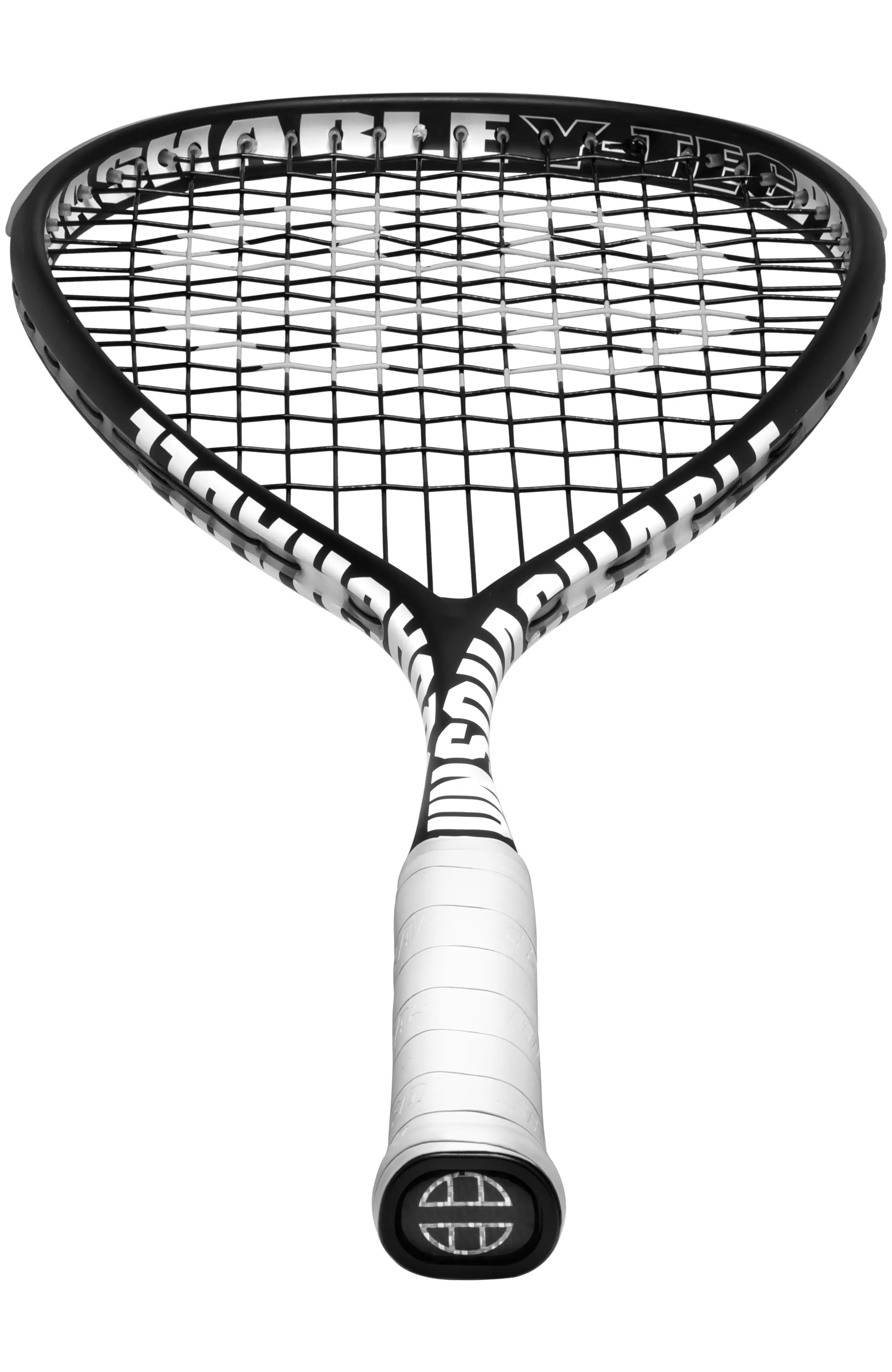
500 cm² teardrop head, 125 g, and a head-light balance. It keeps the forgiveness and easy power of a teardrop, but already reacts quickly at the volley. The brand uses PowerCore construction, and the racquet leaves the factory with Tour-Tec Pro 1.20 string and a PU grip.
- 2
- Weight
- 120 g
- Head
- 77.5 in²
- Strings
- 14x18
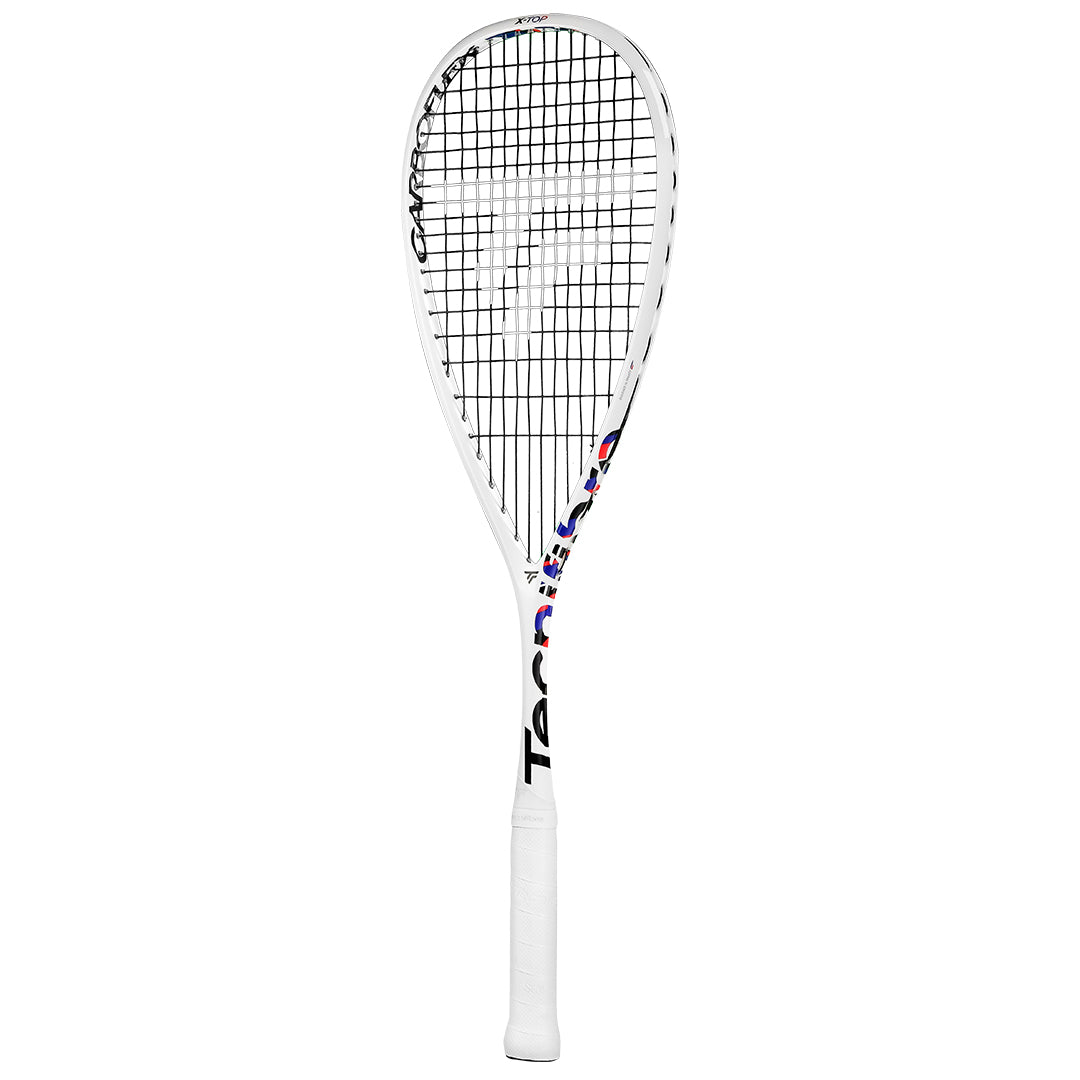
120 g, 500 cm², even balance of 350 mm, and a bumper-free tip. It is the lightest Carboflex of the V2 generation, with the maximum area allowed by the rules. Comes strung with Dynamix VP.
- 3
- Weight
- 120 g
- Head
- 77.5 in²
- Strings
- 12x17
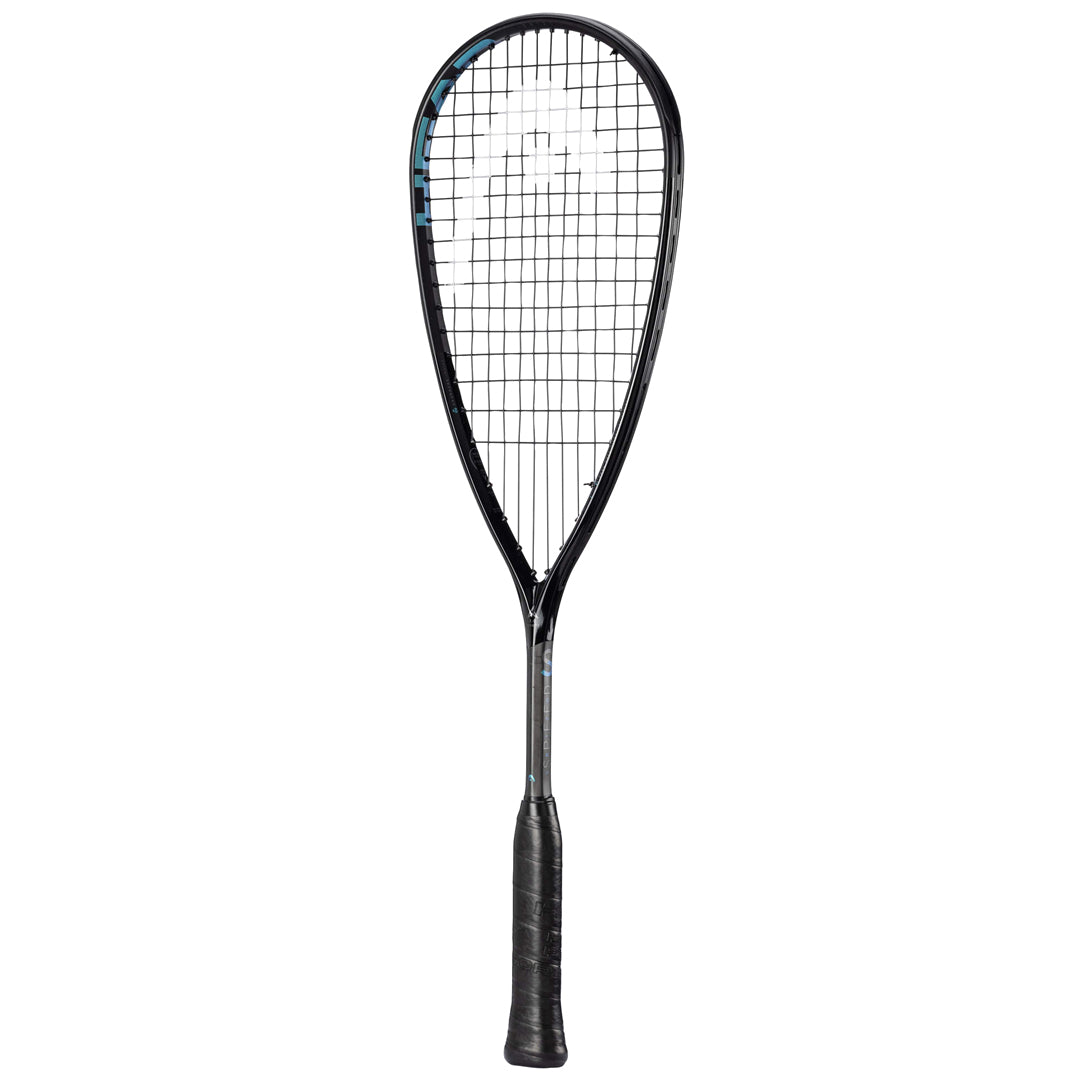
120 g, even balance, 500 cm², and a 16 mm Slimbody frame. A thin frame tends to get through balls stuck to the wall better. The adaptable pattern lets you string it straight (12x17) or in a fan (16x17).
- 4
- Weight
- 132 g
- Head
- 77.5 in²
- Strings
- 16x19
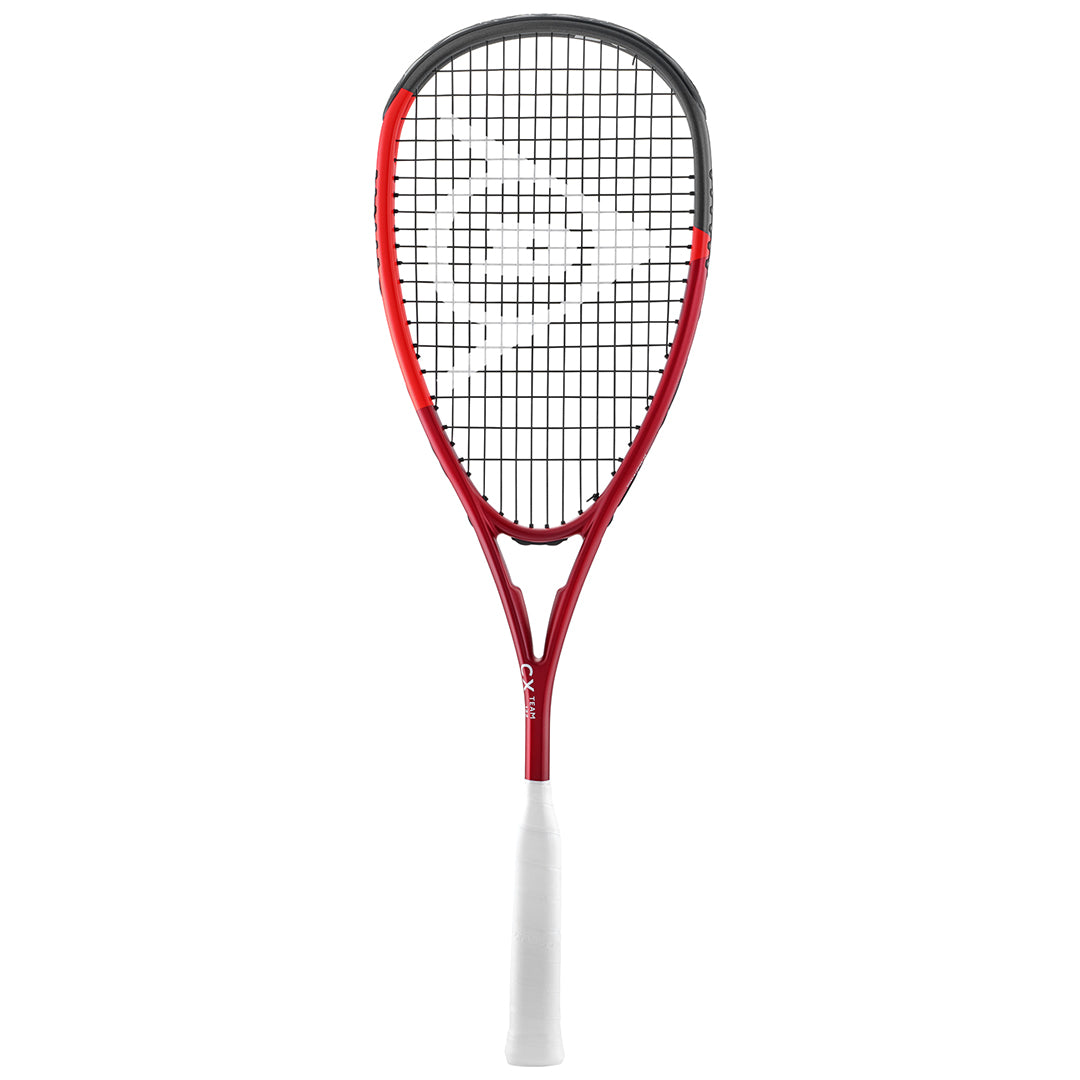
16x19 pattern and 500 cm² like the CX 132, but with a head-heavy balance. The weight at the top gives momentum, which helps offset the denser pattern. Good for players refining precision who still play a lot from the back.
- 5
- Weight
- 135 g
- Head
- 77.5 in²
- Strings
- 12x17
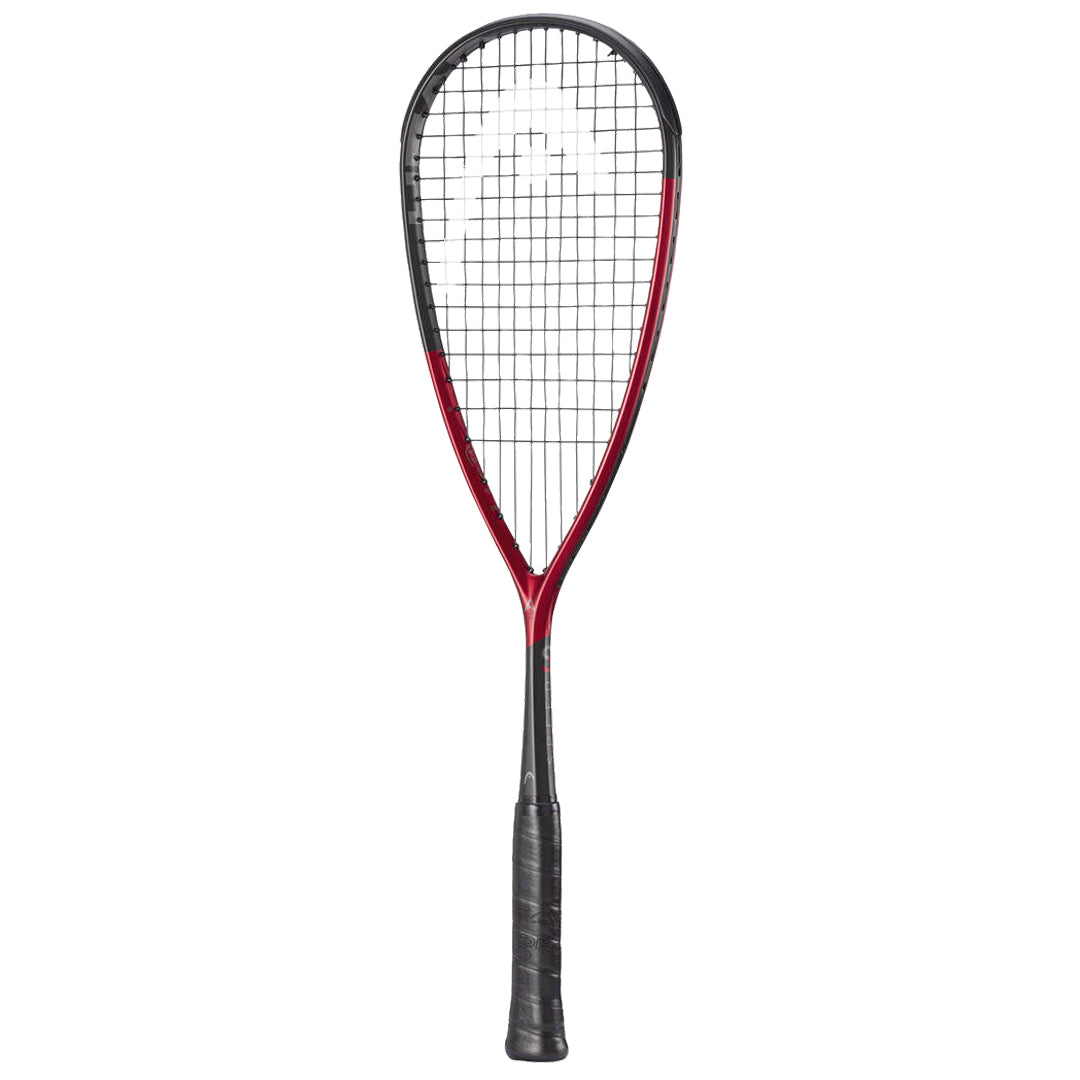
135 g, head-light balance, 500 cm² head, 20 mm frame, and a 12x17 pattern with Adaptive Fan Pattern. Head designed it for the back-court player who wants to add touch: the mass gives weight to long balls and the balance in the hand keeps it from feeling slow at the T. Good for players coming from a heavy racquet who don't want to drop straight to 120 g.






Comparison of the intermediate racquets
In the table, compare weight and balance first, then the string pattern. Those are the three columns that change the feel most for players who already have technique.
Y-Tec Pro, Tour-Tec Pro, FX 115, Carboflex 120, Speed 120 SB, and Ultimate 132
3 racquets: swipe sideways to see them all1–2 of 3 →
Highlighted: what differs between the racquets. In bold: the best value in the row.
Y-Tec Pro or Tour-Tec Pro: teardrop or classic head?
The two Unsquashable racquets at the top of this list show the decision intermediate players face well. They have the same weight, the same area, the same balance, and the same pattern. The difference is the head shape.
- Y-Tec Pro 125 (teardrop): the head narrows toward the handle and the main strings are longer. More rebound, a more elongated sweet spot, power with little effort.
- Tour-Tec Pro 125 (classic): the head is more rounded and the area is distributed more toward the top. The ball comes off with less trampoline effect and more predictability.
If you still depend on the racquet to gain depth, stay with the Y-Tec. If the ball already comes off hard and the problem is precision, go with the Tour-Tec. The guide on open vs. closed throat goes deeper into this choice with more examples.
Strengths
- + 500 cm² teardrop, the maximum under the rules
- + Long main strings from the teardrop shape
- + Head-light balance
- + Tour-Tec Pro 1.20 string and PU grip from the factory
Drawbacks
- − Teardrop shape is usually less predictable than the classic head
- − Weight is listed as dynamic, hard to compare with other brands
When to move to a lighter, control-oriented racquet
The intermediate player's temptation is to buy the pros' control racquet right away. Sometimes it is the right step, sometimes it gets in the way. Use these criteria:
Go to a lighter racquet (115 to 120 g) when:
- You are late on volleys, but not on balls from the back.
- Your arm tires by the third game and your stroke starts to get short.
- You play at a high tempo, with lots of exchanges at the T.
Go to a control racquet (smaller head or dense pattern) when:
- Your drives already reach the back with ease and sometimes go too far.
- Your drops come out high or long, even with good technique.
- You hit the center consistently. A 470 cm² head punishes players who don't.
It is not time yet if:
- You win most of your points from the opponent's errors, not from your placement.
- You still depend on a high, hard ball to get out of trouble at the back.
When you are ready, the Dunlop CX 125 and the Head Radical 135 SB, which appear in the ranking of the best squash racquets of 2026, are the natural destination. The guide to squash racquets for advanced players separates these options by playing style.
Thin frame: what the Head Speed 120 SB changes
Frame thickness is another characteristic that only starts to matter at the intermediate level. The Speed 120 SB has a 16 mm Slimbody frame, versus 20 mm on the regular Speed 120. Two practical consequences:
- Balls stuck to the side wall: with a thin frame, the strings reach the ball before the frame scrapes the wall. Players who hit straight drives often feel the difference.
- Aerodynamics: less frontal area cuts through the air better, and the racquet feels a bit faster in the swing.
The price is raw power: a thin frame flexes more and returns less energy than a thick one. That is why the Speed 120 SB is a racquet for players who already generate speed with technique, not for those who depend on the frame.
If your case is the opposite, and you still play a lot from the back and miss mass, the Head Speed 135 2025 sits at the other end of the same line: 135 g, 20 mm frame, and head-light balance, with the same adaptable 12x17 pattern. Head recommends it for the back-court player who wants to add touch, and it is a gentler step for players coming from a heavy entry-level racquet.
A word on the Dunlop FX 115
The FX 115 is the lightest racquet on this list, at 115 g, and has a combination that seems contradictory: extra head-light balance and a big 500 cm² head. In theory, that joins the agility of low weight with the forgiveness of a big head. The Sonic Core Infinergy at the 2 and 10 o'clock positions and the Flex Touch resin are Dunlop's bets for comfort.
The limitation is physics: with little mass, your opponent's heavy balls push the racquet around. If your opponent hits hard and you play a lot from the back, 125 g is safer. And it is worth knowing that the 2024 generation has already been replaced, which usually makes its offers better value while stock lasts. To see the whole line, use the Dunlop comparison.
How to test before switching racquets
A new racquet changes the feel in the first few matches, and it is easy to confuse novelty with improvement. Before deciding:
- Play at least a few full sessions. First impressions tend to exaggerate lightness or power.
- Test the situations that bother you most. If the problem is the volley at the T, do a volley-only session. If it is the drop, practice drops.
- Watch for fatigue at the end. A racquet that is too heavy shows up in the third game, not in the warm-up.
- Compare with the same string. A racquet with new string always feels better than yours with old string.
String and tension: the adjustment intermediate players tend to forget
Before switching racquets, it is worth trying a different string. Two simple rules:
- Thinner string (around 1.10 to 1.15 mm) grabs the ball more and gives more feel, but lasts less. Thicker string (1.25 to 1.30 mm) lasts longer and is a bit less lively.
- Lower tension makes the strings more elastic and increases power; higher tension firms up the stringbed and favors control.
If your current racquet already has the right weight and balance, but the ball comes off too long, raising the tension a little may solve it before you spend on another frame. The details are in the guide on how to choose a squash racquet.
To cross-check the options against your profile, Find Your Racket filters the squash catalog by level and style, and the squash comparison tool puts the spec sheets side by side.
What is the best squash racquet for an intermediate player?
A racquet of 120 to 130 g, with an even or head-light balance and a head close to 500 cm². The Unsquashable Y-Tec Pro 125 is the safest choice for players moving on from an entry-level racquet. Players who want more control can go for the Tour-Tec Pro 125; those who want the lightest racquet, for the Dunlop FX 115, at 115 g.
Squash racquet with head-heavy or head-light balance?
Head-light (or even) for players who volley a lot and play up front, because the racquet reacts faster. Head-heavy for players who still need help generating depth, because the mass at the top carries the ball. Intermediate players usually do better with an even balance.
What is the difference between 14x18 and 16x19 string patterns?
16x19 has more strings, closer together. The ball comes off on a more predictable trajectory with less rebound, which favors control. 14x18 is more open: it gives more power and more bite, with a bit less precision. It is the most common pattern in squash.
When should I switch to a lighter squash racquet?
When you are late on volleys, your arm tires at the end of matches, or you play at a very fast tempo. Ranges of 115 to 120 g help in these cases. If you play a lot from the back against strong opponents, a very light racquet can lose stability.
Is a control racquet better for an intermediate player?
Only when power is no longer the problem. Control racquets have a smaller head or a dense pattern and ask you to hit the center and generate speed with your own swing. If you still depend on the racquet to take the ball to the back, a control racquet will make your game shorter.
Where to buy the racquets in this guide
- Y-Tec Pro 125 Unsquashable125 g · 77.5 in² · 14x18See priceRacquet Science
- Carboflex 120 X-Top V2 Tecnifibre120 g · 77.5 in² · 14x18See priceAmazon
- Speed 120 SB 2025 HEAD120 g · 77.5 in² · 12x17See priceAmazon
- CX Team 132 2025 Dunlop132 g · 77.5 in² · 16x19See priceAmazon
- Speed 135 2025 HEAD135 g · 77.5 in² · 12x17See priceAmazon
The prices above are checked automatically at each store and may have changed since the last check. The price that counts is the one shown on the store's website at checkout. We may earn a commission on purchases made through store links, at no extra cost to you.