


 Brasil
 Canada
 United Kingdom
 Australia
 Netherlands
 France
 España
 Italia
 السعودية
Beach Tennis Racket for Attack or Defense: What Changes on the Spec Sheet
Balance, weight, thickness and core for each role on court: baseline attacker, net attacker, baseline defender and net wall, with real rackets for each one.
Updated on 10/07/2026
On this page
- 1.Quick answer: the spec sheet for each role
- 2.What the racket does on each stroke
- 3.Balance: the spec that most separates attacker from defender
- 4.Stability: why the defender wants thickness
- 5.Firm core: an attacker's weapon, at a cost
- 6.Rackets by role
- 7.Counterweight: one racket for two roles
- 8.Decision tree
- 9.Three common mistakes
A beach tennis racket for attack has more mass in the head, a firmer core and a stiff face, to turn a high ball into a point. A racket for defense has a thicker profile, soft EVA and a neutral or low balance, to hold a heavy ball without effort. What really decides it is where you spend the point, at the baseline or at the net, and what you do there. Below, each role becomes spec-sheet numbers, with real rackets from the catalog.
Quick answer: the spec sheet for each role
| Role | Weight | Balance | Thickness | Core | Face |
|---|---|---|---|---|---|
| Baseline attacker | 330 to 350 g | Medium-high or head-heavy (27 cm or more) | 20 to 22 mm | Soft or medium; hard only with technique | 12K to 24K or Kevlar |
| Net attacker | 315 to 330 g | Medium (25 to 26 cm) | 20 to 21 mm | Medium or hard for those with technique | 3K to 18K |
| Baseline defender | 320 to 335 g | Medium | 22 to 24 mm | Soft | 3K, Kevlar or fiberglass |
| Net defender | 315 to 330 g | Low to medium (up to 25.5 cm) | 21 to 22 mm | Soft | 3K |
The numbers are guideline ranges, not rules. Almost every player attacks and defends in the same point; the question is which of the two you do more and which you miss more because of your racket.
If you play in a fixed pair and want to know how to split rackets between the two sides, the guide to beach tennis rackets for intermediate players has a short section on that. Here the focus is your style, stroke by stroke.
What the racket does on each stroke
In beach tennis the ball cannot bounce on the sand, so almost every stroke is a volley. That leaves the racket exposed: there is no time to adjust your body, and the spec sheet shows up on every ball.
| Stroke | What the racket needs to do | What helps on the spec sheet |
|---|---|---|
| Smash | Transfer maximum energy on a high, still ball | Mass in the head, higher weight, firmer core |
| Rapid-fire exchange | Arrive first and turn the face quickly | Low weight, medium or low balance, thin profile |
| Block at the net | Not give when the ball arrives hard | 22 mm profile, reinforced throat, weight in the middle |
| Smash return | Absorb a very fast ball and send it back high | Thickness, soft EVA, big sweet spot |
| Defensive lob | Hold the ball on the face and give height with control | Soft EVA, rough surface |
| Drop shot | Kill the speed of the ball | Soft EVA, thin profile to feel the touch |
| Serve | Generate speed and spin on a still ball | Mass in the head for speed, rough surface for spin |
Note the conflict: what helps the smash (mass in the head) hurts the rapid-fire exchange (which calls for a quick racket). What helps the smash return (soft, thick EVA) takes a little precision away from the attack. That is why there is no racket that is the best at both roles. There is the one that misses least in the role you play most.
Balance: the spec that most separates attacker from defender
Balance is the point of equilibrium measured from the base of the handle. At the same weight, a racket with more mass in the head carries more inertia on the smash and the serve. One that is head-light turns faster for the volley.
The catalog shows that this spec is little explored: of the rackets with a listed balance, the great majority are balanced. Only 11 models are "more weight in the head" and 4 are "lighter in the head." Quicksand is the brand that best shows the difference within a single collection:
Quicksand 2025: No Look Classic (head-light), Enigma and Kombat (head-heavy)




Highlighted: what differs between the racquets. In bold: the best value in the row.
- No Look Classic 2025: balance of 23.5 to 25 cm, the lowest of the brand. Head-light and easy to maneuver, good for those who defend and react at the net.
- Enigma 2025: 26.6 to 27.5 cm, with a weight between 330 and 336 g. Quicksand describes it for players who like to play with power.
- Kombat 2025: 27.5 to 28.4 cm, a weight between 330 and 337 g and a 20 mm profile. The mass goes to the head to help on the smash and the baseline ball, and the thin profile tries to give the agility back.
Between the No Look and the Kombat, the balance point changes from 2.5 cm to almost 5 cm, depending on the unit. In the hand, that changes the racket more than swapping the face carbon. If you are torn between attack and defense, hold both: the feel explains the rest of this guide.
Stability: why the defender wants thickness
Defending in beach tennis is almost always receiving a ball that comes faster than you would like. The opponent's smash arrives from above, close to your body, and you have a split second to get the face in front. At that moment, three things help:
- Thickness. A 24 mm racket has more material between the faces and a stiffer face, which reduces twisting when the ball hits off-center. The Shark Giant 2025 and the Sandever BTR 500 are the two 24 mm rackets in the catalog.
- Soft EVA. The foam deforms more, the ball stays a moment longer on the face and you gain control to return it high. It is the lob that saves the point.
- Weight in the middle. A medium balance keeps the racket stable on the block without making it slow.
The physics of thickness and core, with pairs of rackets that isolate each variable, is in the guide to beach tennis racket thickness and core.
Firm core: an attacker's weapon, at a cost
A high-density EVA deforms little and returns the ball almost instantly. For those who hit clean and hard, that means precision and speed without the feeling of the ball "sinking" into the face. For those who miss the center, it means a ball without direction and vibration in the arm.
The catalog has few rackets with a hard core, and they are all recommended for advanced players:
- Heroe's Aura 2026: Hard EVA with 21K Silver carbon and 22 mm. A dry, direct hit, according to the spec sheet.
- Sandever BTR 960 Blast: high-density Black EVA at 350 g. Mass and firmness for heavy balls and the smash.
- Drop Shot Conqueror 13 Tech: high-density Tech EVA with a 24K Twill face.
If your arm has ever complained, attack with soft or medium EVA and leave hard for later. A firm face over soft EVA, as on Drop Shot's 24K rackets with Soft EVA, is the safest middle ground. The guide to 3K, 12K, 18K and 24K carbon explains why the face alone does not define power.
Rackets by role
If you attack from the baseline
You wait for the high ball, finish with a smash and serve hard. You need mass, preferably in the head.
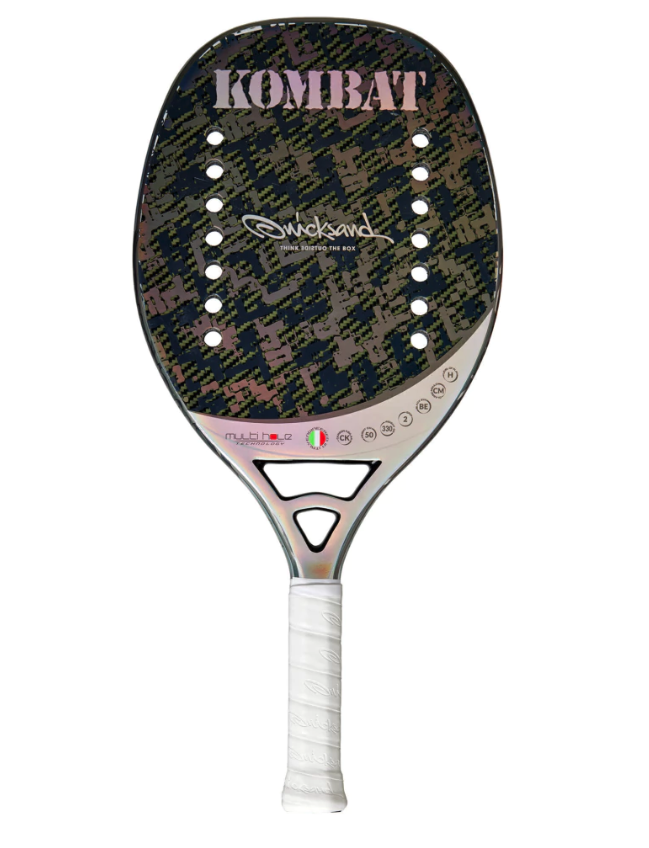


Balance of 27.5 to 28.4 cm, the highest in the Quicksand 2025 line, with 330 to 337 g, carbon and Kevlar. Made for the smash and the baseline ball; the 20 mm profile helps keep it from being too slow.
If you attack at the net
You move up early and decide with rapid-fire exchanges and the downward volley. You need a quick racket that does not give.
If you defend from the baseline
You return smashes, lift lobs and wait for the error. You need stability and comfort.
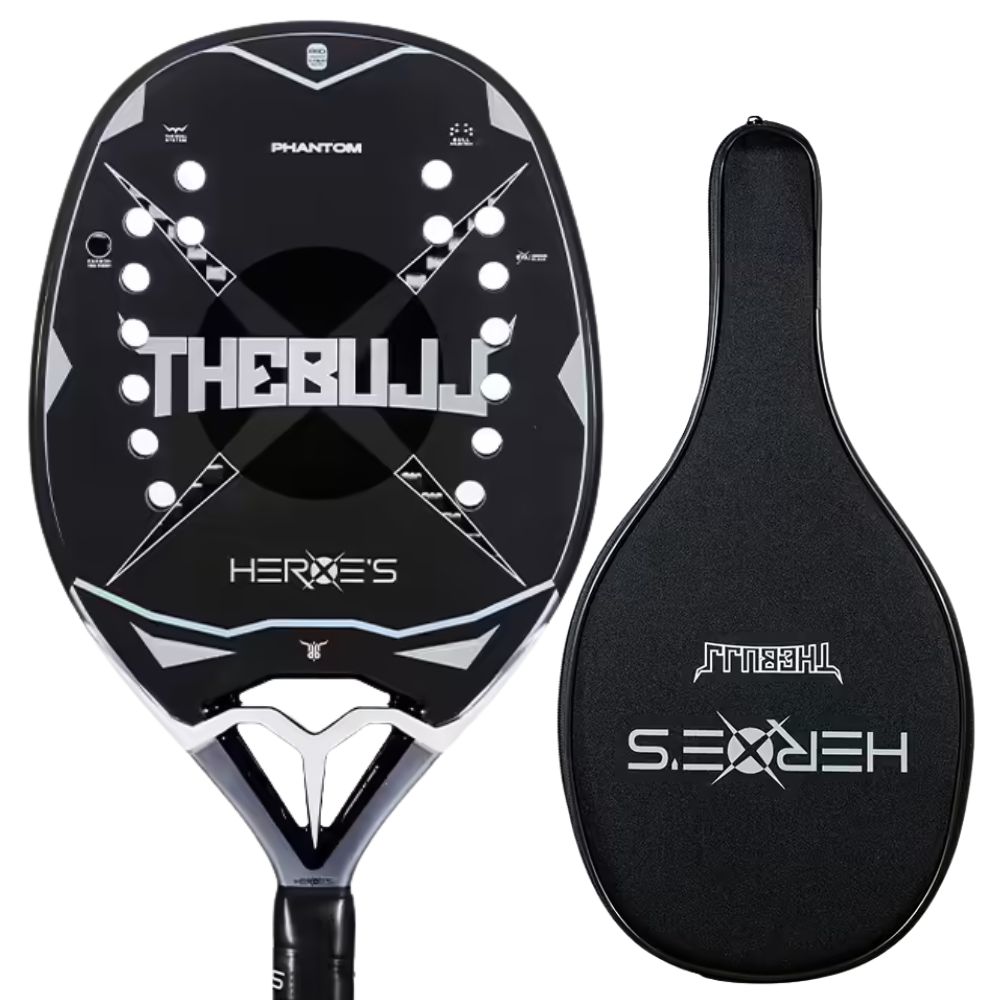
Heroe's· Beach Tennis
The Bull 2026 Diego Bollettinari Heroe's
- Weight
- 325 g
- Face
- 12K carbon
- Thickness
- 20 mm

12K carbon, Medium EVA and the Bull System frame, which Heroe's describes as vibration absorption to give comfort and control on defense. For advanced players who build the point with patience.
If you are the net wall
You block, return everything and wait for your partner to finish. You need a light head and comfort.
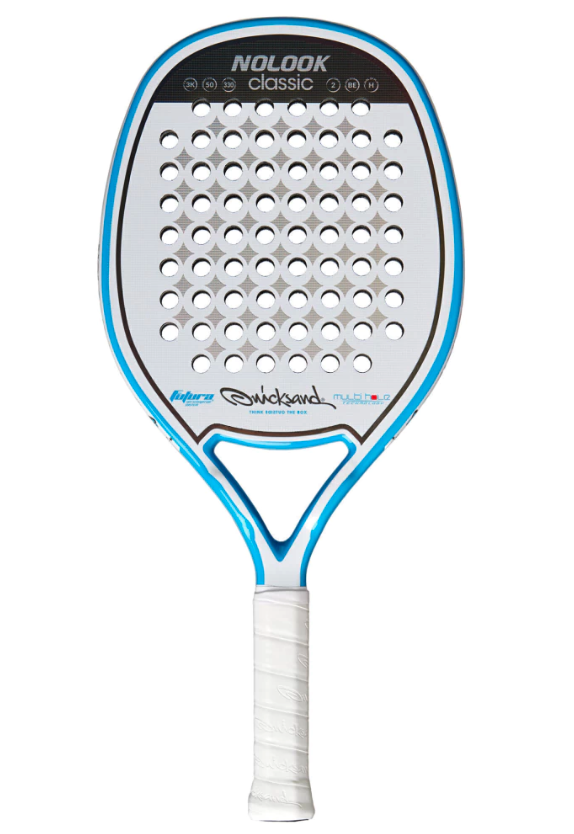
Balance of 23.5 to 25 cm, the lowest at Quicksand, with 3K carbon, Black EVA and 22 mm. The light head turns quickly on the block; the trade-off is less ball weight on the attack.
If you do both
If you switch roles depending on your partner or the point, stay in the middle of the chart: medium balance, 21 to 22 mm, soft or medium EVA.
Counterweight: one racket for two roles
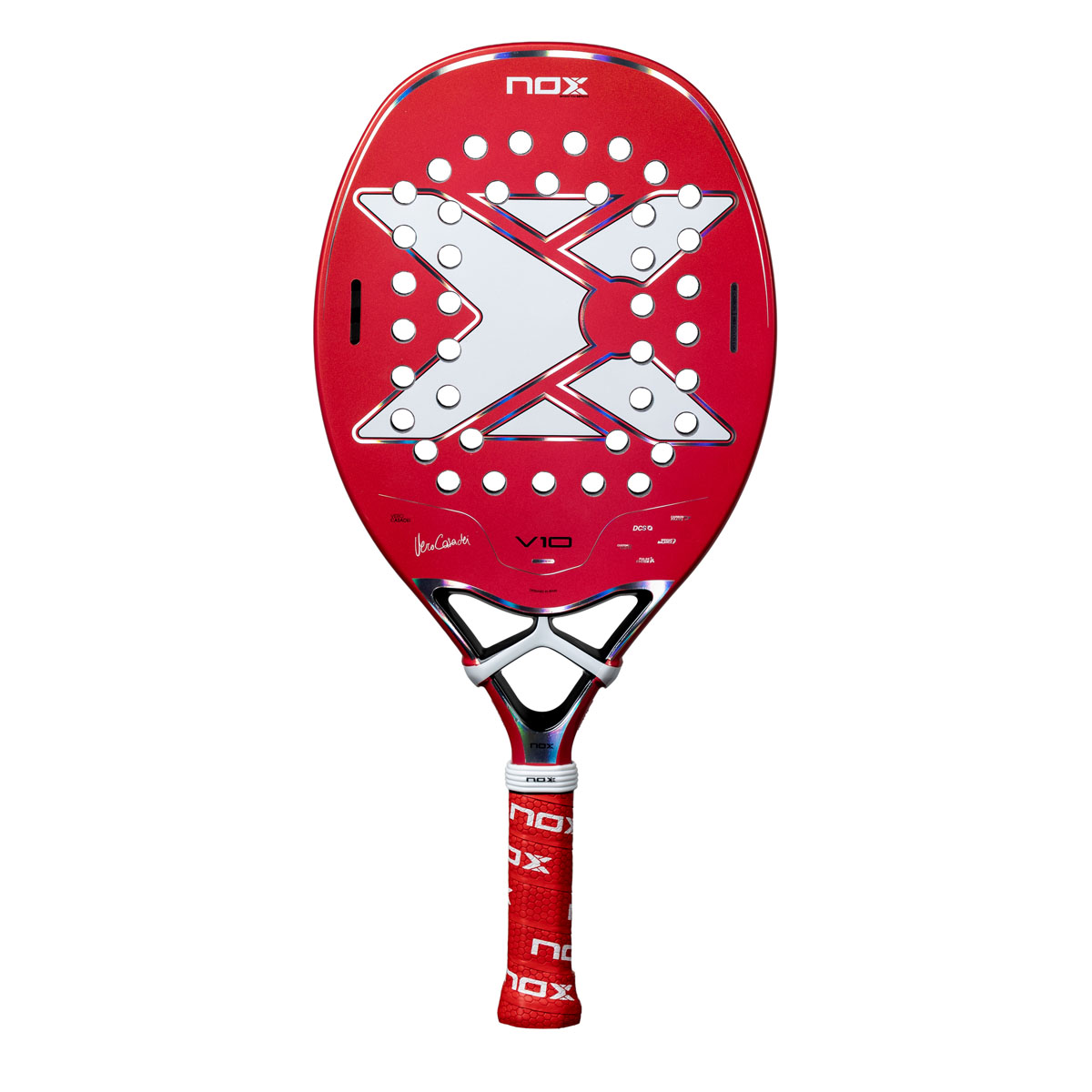
Some NOX rackets come with the Weight Balance system, with interchangeable 2 g and 4 g counterweights to adjust weight and balance. They are on the Fly10 3K 2026, the V10 2026 and the Varadero 3K 2026. The idea is useful for those who alternate roles: more weight for a more aggressive day of play, less weight for a day at the net. Adjust in small steps and play a few matches before changing again.
NOX rackets with adjustable counterweights

The ITF rules allow modifying the racket, as long as it stays within the official dimensions and the tournament does not prohibit it. The guide to how to choose a beach tennis racket summarizes those dimensions.
Decision tree
- Where do you spend most of the point?
- Near the net: go to step 2.
- At the baseline: go to step 3.
- At the net, do you attack more or block more?
- Attack with rapid-fire exchanges: 20 to 21 mm, medium balance, weight of 315 to 330 g. Go to step 4.
- Block and return: 21 to 22 mm, light head, soft EVA. Done.
- At the baseline, do you finish more or defend more?
- Finish with the smash: head-heavy balance or weight above 330 g. Go to step 4.
- Defend and lift lobs: 22 to 24 mm, soft EVA, medium balance. Done.
- Can your arm handle a firm core?
- Yes, and you hit the center consistently: medium or hard EVA.
- No, or you are not sure: soft EVA with a firm face (12K to 24K).
- Compare the finalists in the beach tennis comparison tool and check that the listed weight matches the range for your role.
Three common mistakes
- Copying your idol's racket. Signature rackets are made for that athlete's role, with their technique. If you play differently, the spec sheet works against you.
- Choosing for the role you want to have. If you still spend most of the point defending, an attacking racket will punish exactly what you do most.
- Ignoring fatigue. A heavy attacking racket pays off in the first set and charges you in the third. If that is your case, see the light beach tennis rackets with a firm face.
To continue, the beach tennis catalog lets you filter by thickness and core, the page for Quicksand in beach tennis shows the whole line with different balances, and the Find Your Racket quiz does the screening from your answers.
Where to buy the racquets in this guide
- No Look Classic 2025 Quicksand328 g · 3K carbon · 22 mmSee priceBeach Tennis Depot
- Kombat 2025 Quicksand333 g · Carbon and Kevlar · 20 mmSee priceiamBeachTennis
- The Bull 2026 Diego Bollettinari Heroe's325 g · 12K carbon · 20 mmSee priceBeach Tennis Depot
- V10 2026 by Vero Casadei NOX330 g · 12K carbon · 20 mmSee priceiamBeachTennis
The prices above are checked automatically at each store and may have changed since the last check. The price that counts is the one shown on the store's website at checkout. We may earn a commission on purchases made through store links, at no extra cost to you.