


 Brasil
 Canada
 United Kingdom
 Australia
 Netherlands
 France
 España
 Italia
 السعودية
How to Choose a Beach Tennis Racket: The Complete Buying Guide
Weight, balance, EVA core, thickness, hole pattern and surface explained with catalog examples, plus the maximum dimensions the ITF allows.
Updated on 10/07/2026
On this page
- 1.Quick summary: what to choose for each level
- 2.ITF rules: what a beach tennis racket can have
- 3.Weight: the variable you feel in the third set
- 4.Balance: where the weight sits
- 5.EVA core: soft, medium, hard or mixed
- 6.Thickness: 20, 22 or 24 mm
- 7.Face: fiberglass, carbon, kevlar
- 8.Hole pattern: how many holes and where
- 9.Surface: roughness, sand and spin
- 10.Grip and overgrip
- 11.Length: when 50 cm isn't ideal
- 12.Catalog examples by need
- 13.Step by step to choose your beach tennis racket
- 14.Frequently asked questions
Knowing how to choose a beach tennis racket comes down to getting five variables right: weight, balance, EVA core, thickness and face surface. The face material (fiberglass, 3K carbon, 12K, kevlar) matters, but it affects the feel less than most people think. This buying guide explains each criterion with real catalog examples and ends with a step-by-step process so you can decide in five minutes.
Quick summary: what to choose for each level
| Criterion | Beginner | Intermediate | Advanced |
|---|---|---|---|
| Weight | 315 to 330 g | 315 to 335 g | 320 to 345 g |
| Core (EVA) | Soft | Soft or medium | Soft, medium or hard |
| Thickness | 22 mm | 21 to 22 mm | 20 to 22 mm |
| Face | Fiberglass or 3K carbon | 3K or 12K carbon | 12K, 18K, 24K or kevlar |
| Surface | Rough from the factory | Rough or 3D | Depends on your style |
| Balance | Medium | Medium | Low to high, depending on your game |
If you'd like to go straight to the models, we have ready-made selections of rackets for beginners, for intermediate players and the overall 2026 ranking.
ITF rules: what a beach tennis racket can have
The International Tennis Federation (ITF) sets the rules of beach tennis, and Appendix II of the ITF Rules of Beach Tennis establishes the maximum racket dimensions:
- Length: up to 50 cm, from the base of the handle to the tip of the head.
- Head width: up to 26 cm.
- Thickness (profile): constant and no more than 38 mm.
- Hitting area: a flat surface up to 30 cm long by 26 cm wide.
- Holes: holes larger than 13 mm in diameter may not be more than 40 mm from the rim, except those that are part of the throat.
- No strings: a strung racket is not allowed.
The rule sets no weight or number of holes. That's why the market has rackets from 305 to 355 g and from 10 to more than 80 holes. In practice, almost all of them use the maximum length of 50 cm and thicknesses between 20 and 24 mm, well below the 38 mm limit.
The ITF also allows players to alter a racket's characteristics, such as applying a face treatment or an overgrip, as long as it stays within the specifications and the tournament doesn't prohibit it.
Weight: the variable you feel in the third set
Weight determines stability and fatigue. A heavier racket holds up better against your opponent's hard shots (the head doesn't "bounce back" on impact) and carries more inertia on the smash. A lighter one gets there sooner on the volley and tires the shoulder less.
In the catalog, most rackets fall between 315 and 335 g. Outside that range are specific cases: the Adidas Metalbone H14, at 300 to 310 g, and the Sexy models at 345 to 355 g, such as the Rasta Lion 2G.
Two practical points:
- Weight as a range. Many spec sheets say "310 to 330 g." The variation between units is real and can exceed 10 g.
- Static weight is not weight in motion. Two 325 g rackets can feel different because of their balance.
Balance: where the weight sits
Balance is the point of equilibrium measured from the base of the handle. The vast majority of beach tennis rackets have a medium balance, between 25 and 26.5 cm.
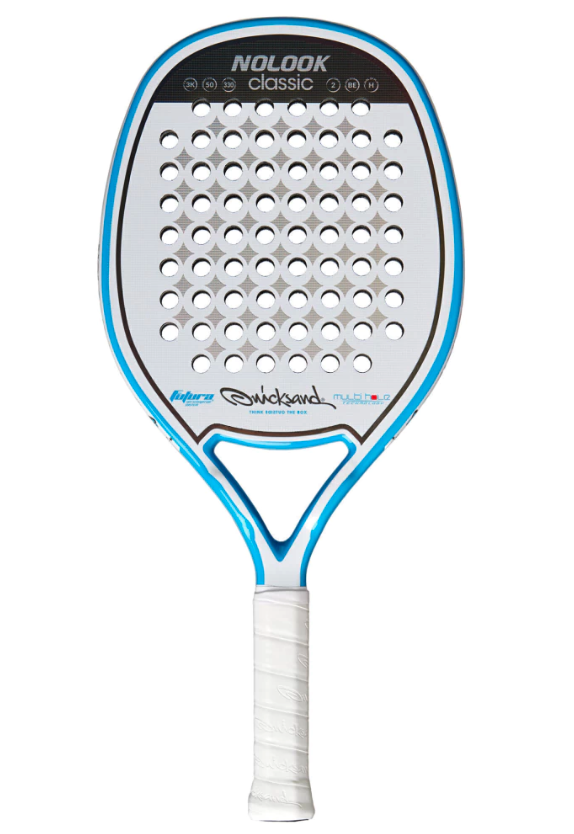
- Low balance (head-light): faster reaction at the net, less power on the smash. Example: Quicksand No Look Classic 2025, at 23.5 to 25 cm.
- Medium balance: the market standard, good for those who alternate between defense and attack.
- High balance (head-heavy): more power from the baseline, slower reaction. It shows up in only a few models, such as the Compass Trend 12K and the NOX MB10 18K Luxury.
EVA core: soft, medium, hard or mixed
The core is the EVA foam between the two faces, and it's what changes the feel of the hit the most. When the ball hits, the foam deforms and then returns the energy.
- Soft EVA: deforms more. The ball comes off with little effort, the sweet spot is more forgiving and there's less vibration. It's the type in more than 80% of catalog rackets that list the core.
- Medium EVA: more control and power on full swings, with less damping. Common in advanced-level rackets.
- Hard EVA: barely deforms and returns the ball fast and precisely. It demands a clean hit and transmits more vibration. Good for technical attackers, bad for a sensitive arm.
- Mixed or layered cores: some brands combine densities. Shark, for example, uses three-layer Soft Pro EVA in 2026 models. The idea is to join the ball exit of soft with the firmness of a denser layer.
The best example of the core's effect is Head's 2025 line: three rackets with the same weight (310 to 320 g), the same length and the same thickness, changing mainly the foam.
The Gravity uses Soft EVA, the Extreme uses Pro EVA of intermediate density and the Speed uses Tech EVA, the firmest of the three. By the general rule of cores, softer foam damps more and tolerates mistakes better, while firmer foam returns the ball faster but demands a clean hit. Putting the three spec sheets side by side shows how changing the foam changes the audience of a single line.
Thickness: 20, 22 or 24 mm
Thickness (or profile) is the distance between the two faces. More thickness means more material at the point of impact: the racket is more stable with a larger sweet spot, but slower through the air. Less thickness makes the racket faster and gives more feel, with a smaller sweet spot.
In the catalog, 22 mm is the standard (more than half the models), followed by 20 mm and 21 mm. Above 22 mm is rare.
Shark offers all three options in similar lines, which makes comparison easier:
- 24 mm (Giant): the thickest profile of the three. As a general rule, more stability and a larger sweet spot, with less agility at the net.
- 22 mm (Predator): the market standard, between stability and speed. The starting point for almost everyone.
- 20 mm (Jaws Tour): the thinnest profile, which tends to be faster and give more feel, with less mass at impact. For the technical net player.
Face: fiberglass, carbon, kevlar
The face is the outer skin that receives the ball. In short:
- Fiberglass: flexible, comfortable and affordable. Less precise and less durable under heavy use. Typical of entry-level rackets.
- 3K carbon: the most flexible of the carbons. Balances comfort and precision.
- 12K, 18K, 24K carbon: strands with more filaments, generally in rackets built for a firmer response.
- Kevlar (aramid): durable, with easy ball exit, used alone or blended with carbon.
The K number is not a synonym for quality or power. The detailed explanation, with myths and examples, is in the guide on 3K, 12K, 18K and 24K carbon.
Hole pattern: how many holes and where
Holes reduce weight and air resistance. In the catalog, rackets range from 10 holes (Drop Shot Explorer Tech 2024) to 82 holes (Sexy SXY Blade, a separate project, with an impact surface of just over 1 mm).
What the hole pattern changes:
- More holes: a racket that's faster through the air, good for the net. NOX uses 40 holes on several rackets in the line.
- Fewer holes: a more solid hit and a bit more continuous area on the face.
- Design: hole placement matters as much as the count. Brands concentrate holes around the sweet spot (Head Gravity) or on the sides (Head Extreme) to change the response and aerodynamics.
Surface: roughness, sand and spin
The face surface determines how much the ball "grips." Of the catalog rackets with a listed finish, the vast majority are rough (microgranules, sand or quartz), some have a molded 3D texture and only a small fraction are smooth.
- Painted rough: immediate spin, but it wears with use and with sand.
- 3D texture: relief in the face itself, more durable. Common on Drop Shot.
- Smooth: shows up on some top-end models, such as the Heroe's Show 2026. It needs an adhesive treatment for those who play with a lot of slice.
The sand on the court works like sandpaper: it drags off the paint and treatment on every ball hit close to the ground. Clean the face after play and store the racket in its cover.
Grip and overgrip
Unlike tennis, beach tennis rackets are rarely sold in different handle sizes. Grip adjustment is done with an overgrip:
- Small hand: a thin overgrip over the original handle.
- Large hand: two overgrips or a thicker base grip.
- Sweat and heat: an overgrip with good absorption, replaced often. A slick grip makes the racket twist in your hand on off-center balls.
Some brands put technology in the handle, such as cork or gel, which brands use to filter vibration (Drop Shot Prisma, Ama Sport Poison Bee). For anyone with arm pain, it's a detail worth considering.
Length: when 50 cm isn't ideal
Almost all rackets are 50 cm. The relevant exception is the Sandever BTR 190, at 47 cm, designed for youth and shorter players. A shorter racket is easier to handle but reduces reach.
Catalog examples by need
A reference racket for each criterion







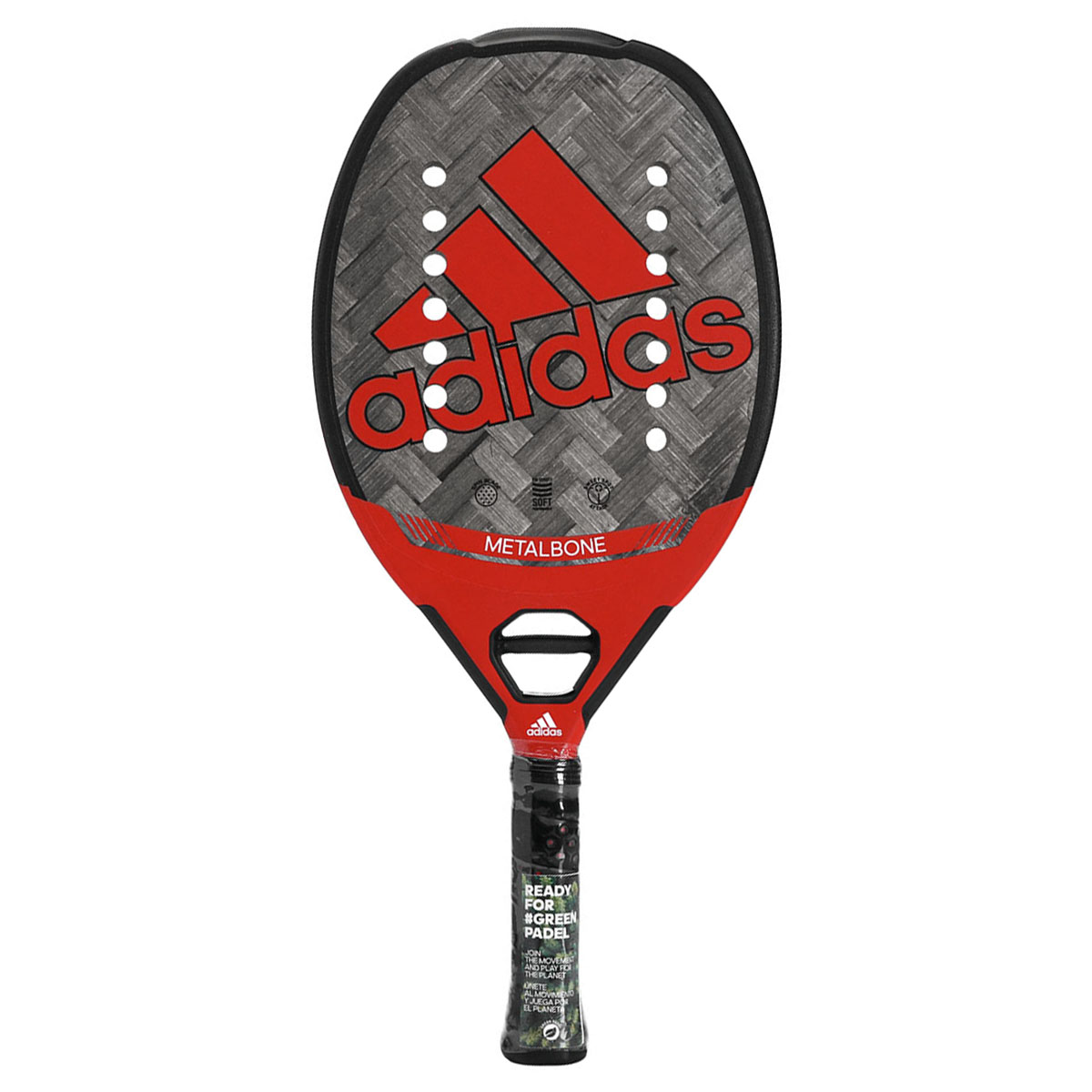
 Adidas Padel· Beach Tennis
Metalbone H14 Adidas Padel
- Weight
- 305 g
- Face
- 24K aluminized carbon
- Thickness
- 22 mm

Step by step to choose your beach tennis racket
- Define your level honestly. If you still miss the center a lot, you're a beginner as far as rackets go, even if you've been playing for a year.
- Choose the core. When in doubt, soft EVA. Medium or hard only if you have the technique and a healthy arm.
- Set the weight range. 315 to 330 g suits most adults.
- Choose the thickness by style. Baseline and defense: 22 mm. Net and reflexes: 20 or 21 mm.
- Choose the face. Fiberglass or 3K to start, 12K to improve, 18K and 24K for those with technique.
- Check the surface. If you like spin and the racket comes smooth, include the treatment in your budget.
- Compare side by side. Put two or three finalists in the beach tennis comparison tool and look at the spec differences.
If you'd rather answer questions about your game and get suggestions, use find your racket. To understand how we calculate the scores, see the methodology. And if you already have a preferred brand, pages like Shark beach tennis and the Drop Shot racket comparison help you choose within the line.
Frequently asked questions
How do I choose a beach tennis racket?
Start with the core (soft EVA when in doubt), then the weight (315 to 330 g for most people), the thickness (22 mm for baseline, 20 to 21 mm for the net) and the face (fiberglass or 3K to start, 12K to improve). Finally, check that the surface is rough, which helps with spin.
What is the maximum size of a beach tennis racket?
Under ITF rules, the racket can be up to 50 cm long, with a head up to 26 cm wide and a constant thickness of up to 38 mm. The flat hitting area can be up to 30 cm by 26 cm. A strung racket is not allowed.
What is the difference between soft EVA and hard EVA?
Soft EVA deforms more on impact: the ball comes off with less effort, the sweet spot is more forgiving and there's less vibration. Hard EVA barely deforms and returns the ball faster and more precisely, but it demands a clean hit and transmits more vibration to your arm.
Is a thicker beach tennis racket better?
It's neither better nor worse, just different. A 22 to 24 mm racket is more stable and has a larger sweet spot, good for defense and baseline play. A 20 mm racket is faster and has more feel, good for net players, but demands more accuracy at the center.
Do I need to treat my beach tennis racket?
Only if it comes smooth and you play with spin. Most rackets already leave the factory with a rough surface or 3D texture. Adhesive treatment is allowed by ITF rules, as long as the racket stays within the official dimensions.
Do beach tennis rackets come in different handle sizes?
In general, not like in tennis. Grip adjustment is done with an overgrip: a thin one for small hands, two or a base grip for large hands. Replacing the overgrip often keeps the racket from twisting in your hand.
How many holes should a beach tennis racket have?
The rules don't limit the number of holes, only the size and position of large holes. In the catalog, there are rackets with 10 to more than 80 holes. More holes make the racket faster through the air; fewer holes give a more solid hit. The design counts as much as the count.
Where to buy the racquets in this guide
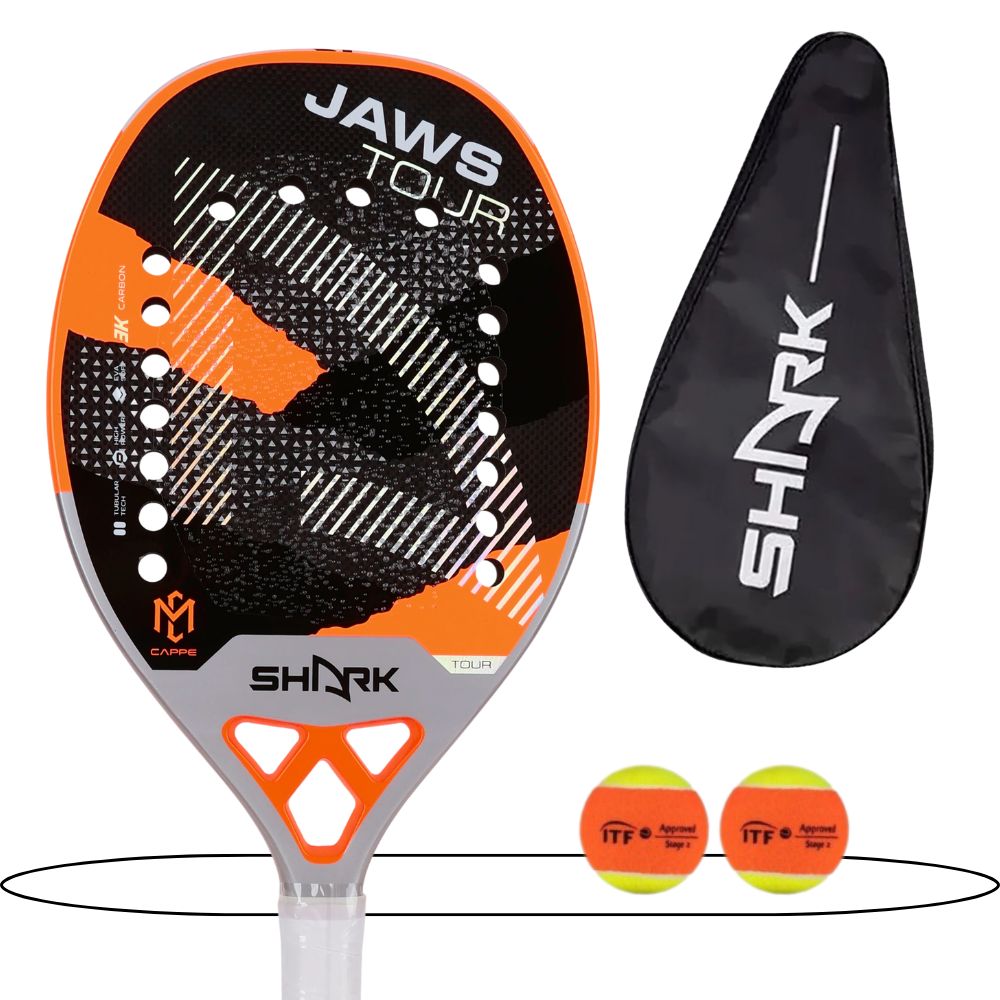 Jaws Tour 20 mm by Michele Cappelletti 2025 Shark325 g · 3K carbon · 20 mmSee priceBeach Tennis Depot
- No Look Classic 2025 Quicksand328 g · 3K carbon · 22 mmSee priceBeach Tennis Depot
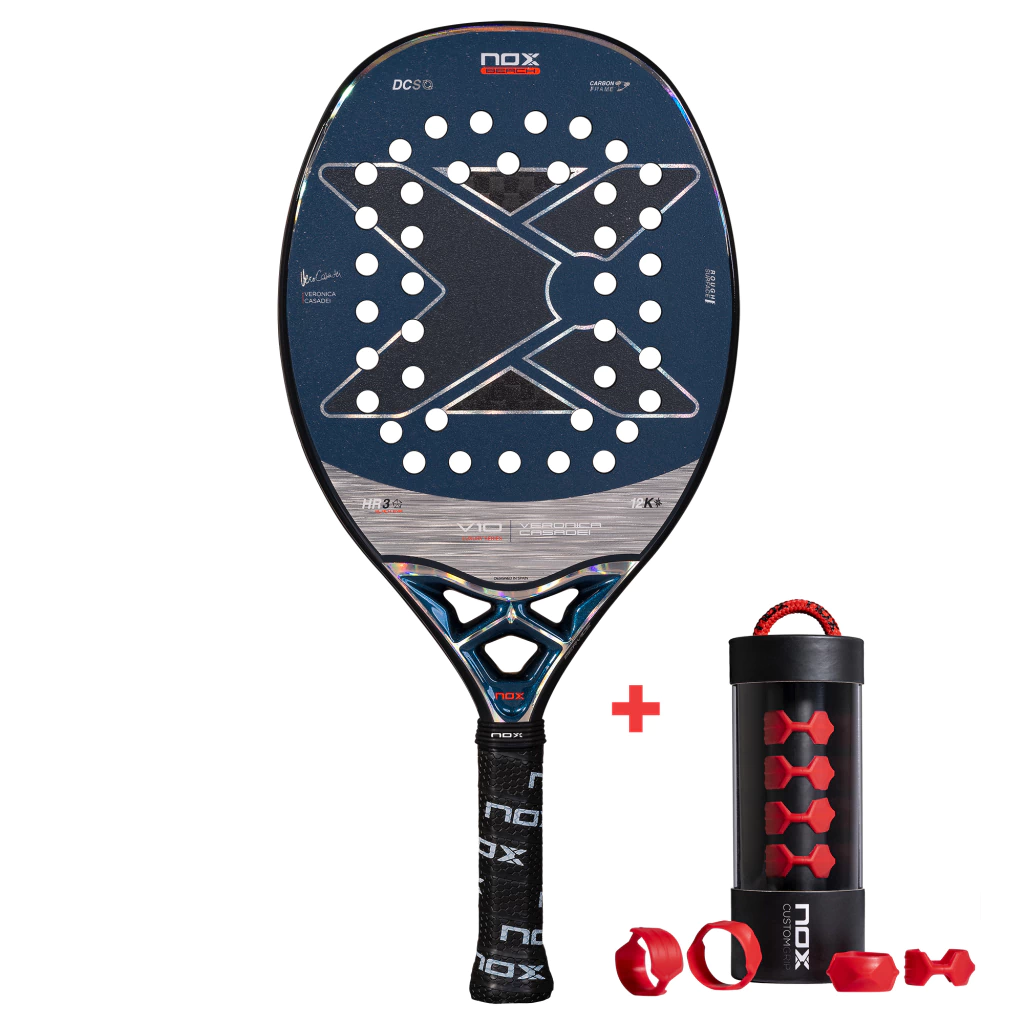
- V10 12K 2025 by Vero Casadei NOX330 g · 12K carbon · 20 mmSee priceBeach Tennis Depot
- Metalbone H14 Adidas Padel305 g · 24K aluminized carbon · 22 mmSee priceiamBeachTennis
The prices above are checked automatically at each store and may have changed since the last check. The price that counts is the one shown on the store's website at checkout. We may earn a commission on purchases made through store links, at no extra cost to you.