


 Brasil
 Canada
 United Kingdom
 Australia
 Netherlands
 France
 España
 Italia
 السعودية
7 Light Beach Tennis Rackets to Play Faster and Tire Less
Seven beach tennis rackets of 300 to 320 g, for those who want hand speed and less arm fatigue, with the signs that a racket has become too light.
Updated on 10/07/2026
On this page
- 1.How much a beach tennis racket weighs
- 2.Who a light beach tennis racket makes sense for
- 3.The price of lightness: signs it became too light
- 4.How to make up for the lack of mass
- 5.The three lightest side by side
- 6.Advertised weight vs. weight in hand
- 7.Still light: options around 320 g
- 8.What about kids?
- 9.Myths and facts about light rackets
- 10.How to decide
A light beach tennis racket, on today's market, is one that weighs up to about 320 g. Most adult rackets fall between 321 and 330 g, and only 2 adult models in our catalog weigh 310 g or less. Lightness gives hand speed at the net and spares the shoulder in long matches, but it costs you in stability. Below are the 7 light rackets that best handle that trade-off and how to know whether low weight is right for you.
The 7 best light beach tennis rackets
- 1
- Weight
- 305 g
- Face
- 24K aluminized carbon
- Thickness
- 22 mm
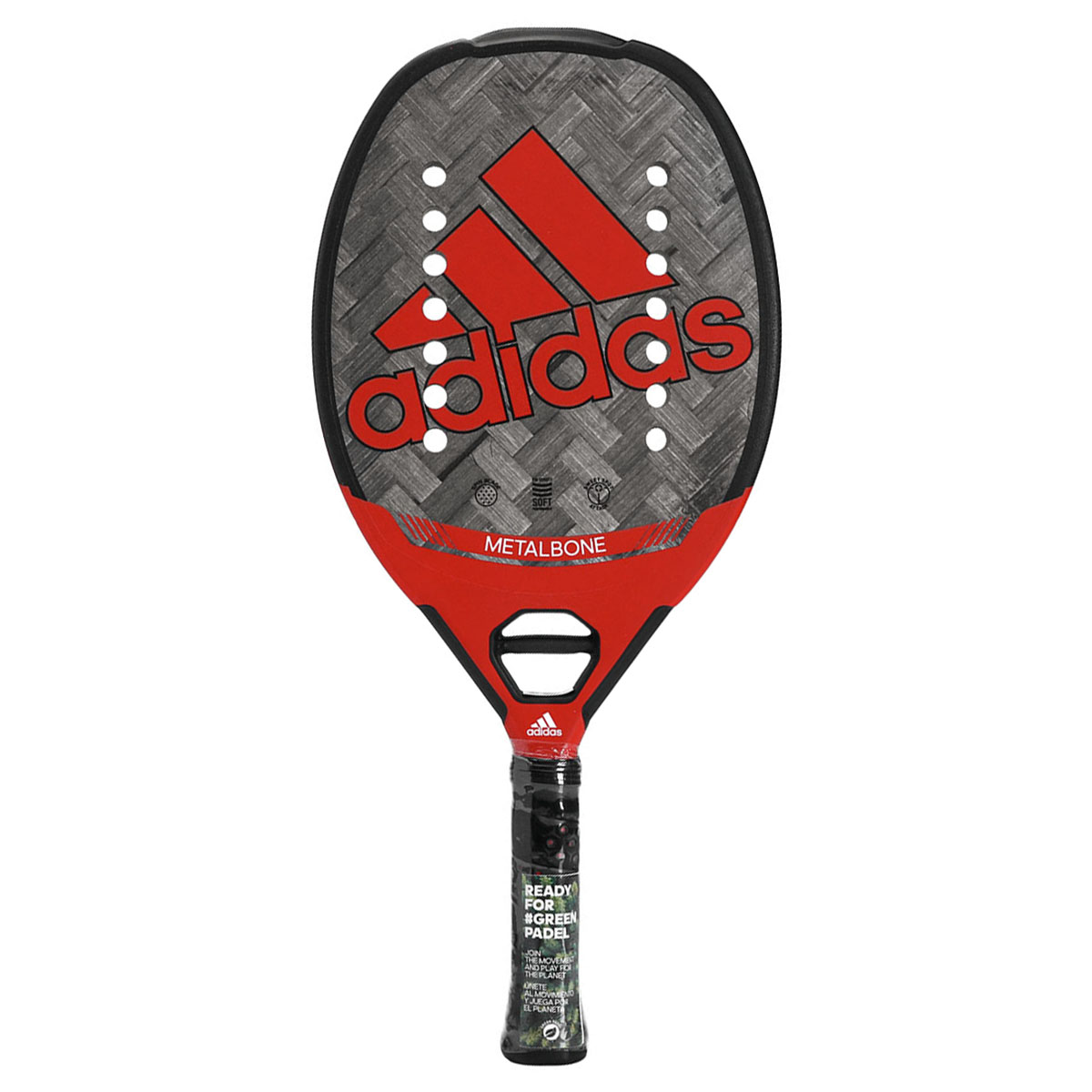
From 300 to 310 g, with a 24K aluminized carbon face, Soft Performance EVA, 22 mm and a balance of 250 mm (±10 mm). The Octagonal Structure reinforces the frame and the 3D-texture Spin Blade helps with spin. It combines two rare things in the same racket: low weight and a firm face. The 22 mm gives back some of the stability that lightness takes away.

How much a beach tennis racket weighs
Weight is the spec that varies the most between brands and the one you feel the most after an hour of play. For reference, see how the 200 adult rackets with a listed weight in the catalog are distributed:
| Weight | How it behaves | Adult rackets in the catalog |
|---|---|---|
| Up to 310 g | Very fast, little mass to hold a heavy ball | 2 |
| 311 to 320 g | Light: fast, still with reasonable stability | 59 |
| 321 to 330 g | The market standard | 87 |
| 331 to 345 g | Heavy: stable, more tiring | 40 |
| 346 g or more | Very heavy, almost all from Sexy | 12 |
The numbers show why "light" is relative. A 320 g racket is already in the lightest third of the market, and below 310 g there are almost no adult options. Kids' rackets, shorter (43 to 48 cm) and generally lighter, are another category (see the end).
Who a light beach tennis racket makes sense for
Those who feel their shoulder or elbow late in the match
In beach tennis, the arm works overhead all the time: serve, smash, high defensive ball. Every gram less is less load on each of those movements. A 305 g racket instead of 335 g is 30 g less lifted hundreds of times per match.
Watch out for the other half of the equation: a light racket has less mass to absorb impact, and more vibration reaches the arm. That is why, for those in pain, lightness needs to come together with soft EVA. The Athena Boreal, with ABS GEL and Delta Rubber in the throat, and the Vision Master, with Extra Soft EVA, follow that logic. Equipment helps, but it does not treat an injury: if the pain persists, see a doctor or physical therapist.
Those who play at the net and live on rapid-fire exchanges
In a quick exchange of volleys near the net, whoever gets the racket ready first wins the point. Low weight and a thin profile make the racket quicker to leave one position and arrive at the other. The Head Boom (20 mm, 310 to 320 g) was designed exactly for this. To understand how court position changes the choice of racket, see the guide to beach tennis racket for attack or defense.
Those with less strength or returning to play
Many women players, older players and those returning after a break do better with a racket that does not tire in the second set. When the arm tires, the stroke is late, and being late generates more errors than lacking mass. Here the Vision Master and the Metalbone Team 3.3 are the most direct recommendations.
Teenagers who have moved on from a kids' racket
Those who have outgrown the 47 cm racket but do not yet have an adult's strength find a natural transition in rackets of 300 to 315 g. The full 50 cm gives reach; the low weight avoids straining the shoulder.
Those who play tournaments with several matches in a day
In amateur tournaments, it is common to play two or three matches on the same day. The difference of 15 to 20 g, multiplied by hours of play, shows up in the last match.
The price of lightness: signs it became too light
A light racket is neither better nor worse; it is a trade-off. These are the signs you have gone too far:
- The racket rotates in your hand when the ball hits off-center, even with a new overgrip.
- Your block comes back short against the opponent's smash or hard rapid-fire shot. There is not enough mass to return the ball's energy.
- The smash takes a lot more arm than before to come off with the same speed.
- You feel more vibration at impact than with your previous, heavier racket.
If two or more of these signs appear, go up 10 to 15 g or choose a light racket with more stability features.
How to make up for the lack of mass
You can have a light racket that is still stable. On the spec sheet, look for:
- A 22 mm profile instead of 20 mm. More thickness makes the face stiffer and the sweet spot bigger. The Metalbone H14, the Athena Boreal, the Centauro 7.0 and the Head Speed are light with 22 mm. The relationship between profile and core is detailed in the guide to beach tennis racket thickness and core.
- A medium balance instead of head-light. With the weight in the middle, a light racket resists twisting better. A light, head-light racket is the quickest, but also the most unstable.
- A reinforced throat. Systems like the Centauro's Power Beam Heart exist to reduce twisting.
- Accessories in the right place. Protective frame tape adds a few grams to the head; the overgrip adds grams to the handle and makes the head relatively lighter. Use that to your advantage.
The three lightest side by side
All three are in the 300 to 320 g range, but they solve different problems. The Vision Master is the lightest and the most forgiving: Extra Soft EVA, a fiberglass-blend face and a low balance, designed for beginner and intermediate players. The Metalbone H14 uses the 22 mm and the 24K aluminized face to give firmness back to a low-weight racket; it suits those who already hit hard. The Head Boom bets on the 20 mm profile for maximum speed at the net and is recommended by Head for advanced players.
Advertised weight vs. weight in hand
On a light racket, factory tolerance matters more. Note how each brand reports it:
- Head lists the Boom and the Speed at 310 to 320 g (±5 g).
- Adidas lists the Metalbone H14 at 300 to 310 g.
- On the Athena Boreal, the units seen ranged from 313 to 318 g.
- Outside the list, models listed as "320 g (±10 g)" can reach 330 g, which is already a standard weight.
If lightness is the reason for the purchase, ask the store to weigh the unit or weigh it at home on a kitchen scale before taking the racket out of the packaging. The difference between two units of the same model can be bigger than the difference between two models.
Still light: options around 320 g
If none of the seven suits your game, these rackets sit around 320 g, at the edge of what we call light, with varied profiles and cores:
What about kids?
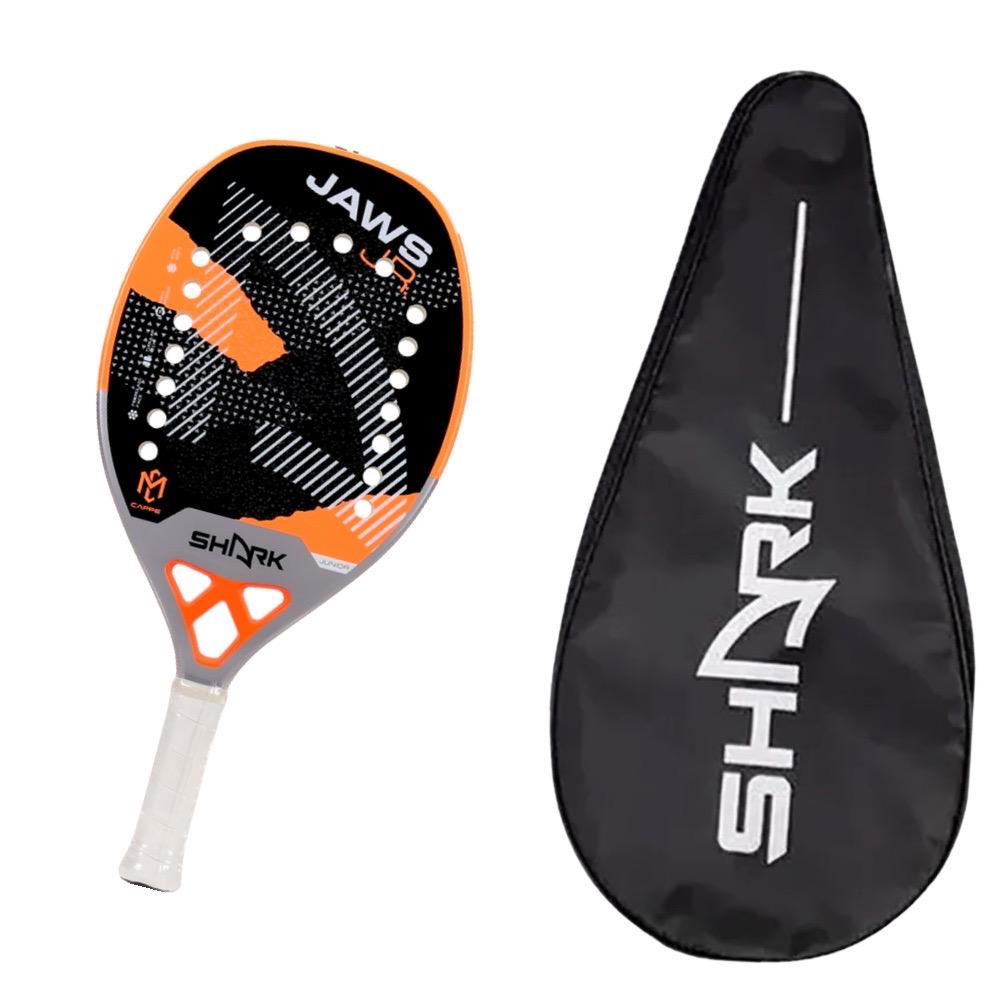
For kids, the path is not a light adult racket but a kids' one, shorter (in the catalog, 43 to 48 cm). The Head Radical Junior (295 g, recommended for ages 8 to 11) and the Shark Jaws Junior 2025 (300 to 310 g, recommended for ages 9 to 12) are examples. The guide to beach tennis rackets for beginners has a section on children, teenagers and people of shorter stature.
47 cm kids' rackets

Myths and facts about light rackets
| Myth | What really happens |
|---|---|
| A light racket is a beginner's racket | Head recommends the Boom and the Speed, both at 310 to 320 g, for the advanced level. Lightness is a style choice. |
| Lighter always protects the arm | Lightness spares the shoulder on acceleration, but there is less mass to absorb shock. Comfort comes from the combination with soft EVA. |
| A light racket has no power | You accelerate a light racket faster. It loses force on the smash and on blocking a heavy ball, not on every stroke. |
| 5 g make no difference | They do, especially if they are in the head. That is why some brands sell 2 g and 4 g counterweights to adjust the balance. |
How to decide
- Weigh your current racket. If it is 330 g and you tire, go down to 315 to 320 g, not straight to 300 g.
- Define the core before the weight. A sensitive arm calls for soft EVA, whatever the weight. The guide to how to choose a beach tennis racket explains the order of decisions.
- Choose the thickness by position. Net: 20 mm. Baseline, or an arm that needs stability: 22 mm.
- Compare the finalists in the beach tennis comparison tool, looking at weight, balance and tolerance.
- When in doubt, the Find Your Racket quiz cross-references your profile with the beach tennis catalog. If budget is the limit, the list of best-value beach tennis rackets brings light options in lower price tiers, and the page for Head in beach tennis gathers the line with 310 to 320 g.
Where to buy the racquets in this guide
- Metalbone H14 Adidas Padel305 g · 24K aluminized carbon · 22 mmSee priceiamBeachTennis
- Jaws Junior 2025 Shark305 g · Fiberglass · 22 mmSee priceiamBeachTennis
The prices above are checked automatically at each store and may have changed since the last check. The price that counts is the one shown on the store's website at checkout. We may earn a commission on purchases made through store links, at no extra cost to you.