


 Brasil
 United States
 United Kingdom
 Australia
 Netherlands
 France
 España
 Italia
 السعودية
7 best tennis racquets for competition in 2026
For tournament players: seven player's racquets, what the ITF rules allow, why you should carry two identical racquets and how to prepare weight, string and a backup for match day.
Updated on 2026-10-07
On this page
A tennis racquet for competition is one you can have in two identical units, strung the same way, and that holds up for three sets against heavy balls without losing its aim. On the spec sheet, that usually means 305 to 320 g unstrung, a 95 to 100 sq in head and, on most models, a swingweight above 320. This guide shows the best tennis racquets for competition in 2026 and what changes when the match counts toward your ranking: what the rules allow, why you should carry an identical backup and how to prepare your gear for the tournament.
The 7 best tennis racquets for competition in 2026
The 7 best tennis racquets for competition in 2026
- 1
- Weight
- 320 g
- Head
- 98 in²
- Strings
- 16x19
- RA
- 67 RA
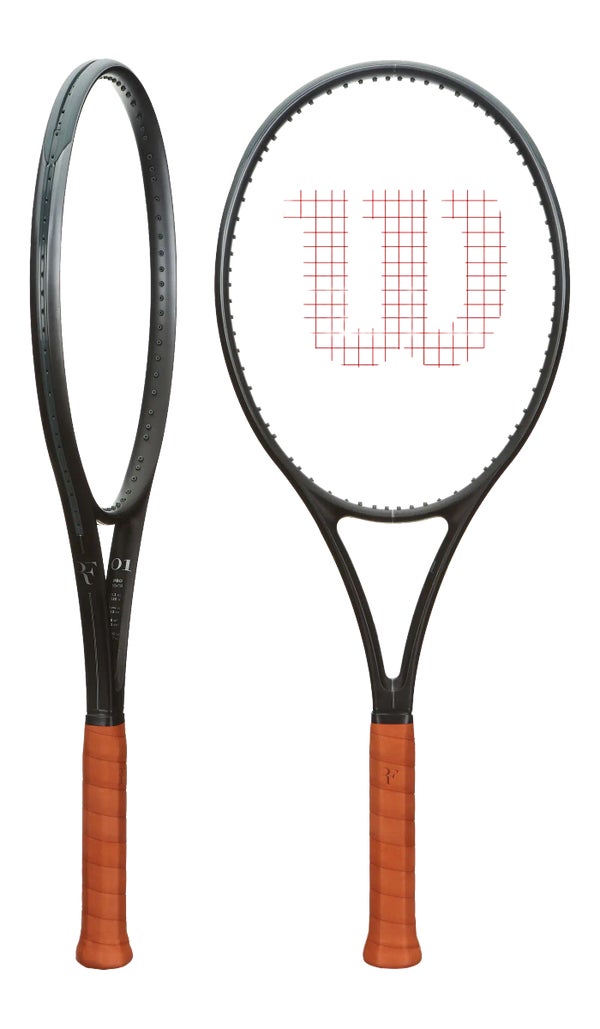
320 g unstrung, 337 g strung, 98 sq in, 16x19, 67 RA and a swingweight of 331. It is the racquet from the collection developed with Roger Federer. Tournament-level stability and weight of shot, for players who have the fitness for three sets at this weight.
- 2
- Weight
- 310 g
- Head
- 95 in²
- Strings
- 16x20
- RA
- 62 RA
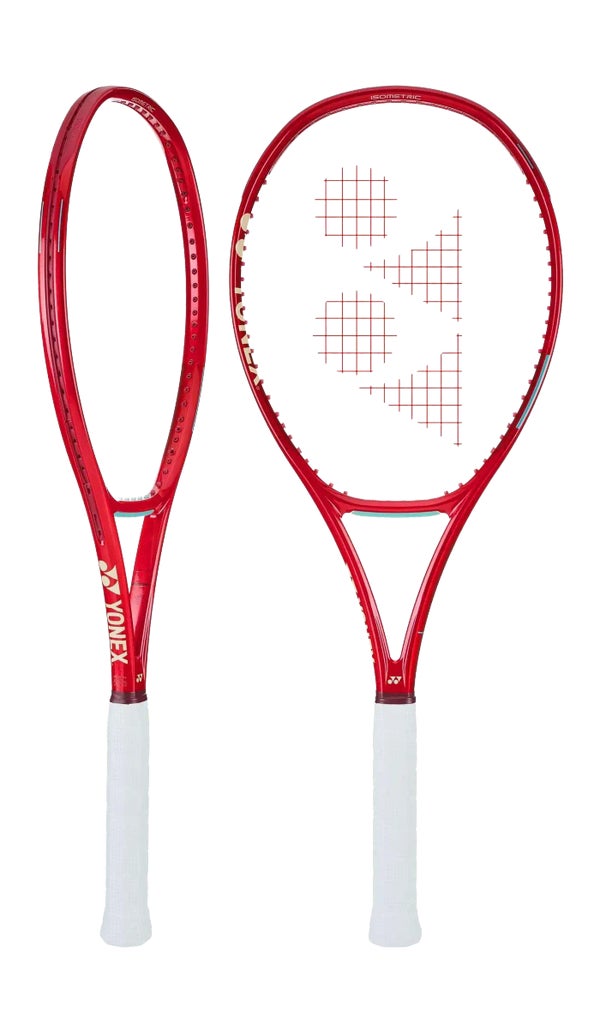
310 g, 95 sq in, 16x20 pattern, constant 22 mm beam, 62 RA and a swingweight of 323. The most compact option in the Vcore line. Very high precision and a penetrating ball, with a small sweet spot. Good for a one-handed backhand, according to the spec sheet.
- 3
- Weight
- 315 g
- Head
- 98 in²
- Strings
- 16x19
- RA
- 65 RA
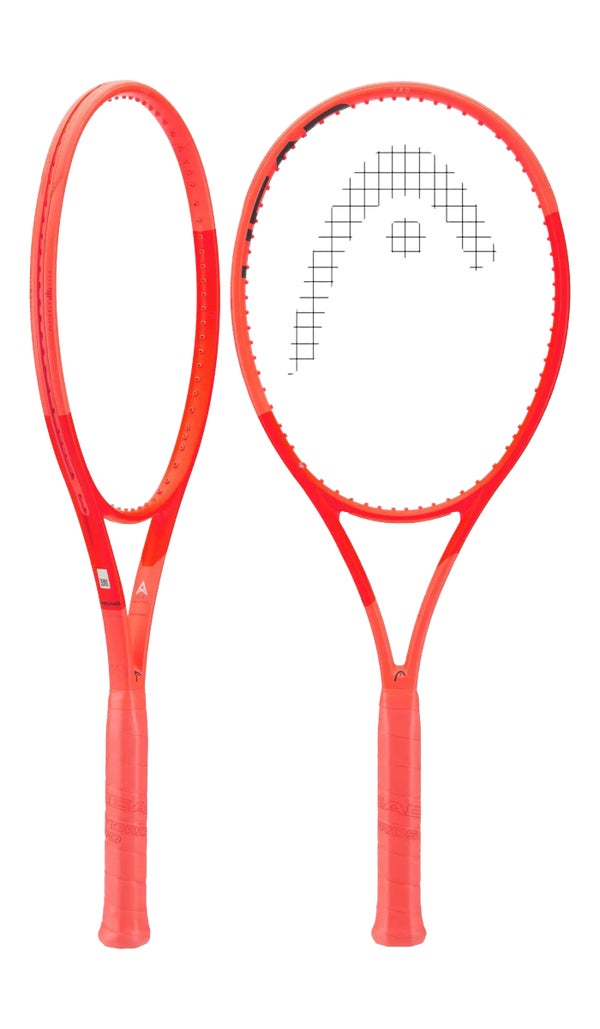
315 g, 98 sq in, 16x19, 20/21.5/21 mm beam, 65 RA and a swingweight of 329. The heavier version of the Radical line, for players who play from every zone of the court and need stability against strong hitters.






The seven were chosen by spec sheet, not by athlete. Three of them are associated by their manufacturers with tour players, but that is included as information, not as a criterion: the racquet that suits a professional may not suit you.
The tournament spec sheet in one table
| Measure | Range in this list | What it solves in a match |
|---|---|---|
| Unstrung weight | 305 to 320 g | Stability on big-serve returns and heavy rallies |
| Swingweight | 323 to 333 in six of the seven | Weight of shot without having to shorten your stroke |
| Head size | 95 to 100 sq in | Precision for aiming near the lines |
| Pattern | 16x19, 16x20 or 18x20 | Choice between spin (open) and low trajectory (tight) |
| Stiffness | 60 to 70 RA | Comfort to play several matches in the same weekend |
If your current racquet is outside these ranges, that doesn't mean it is banned or bad for tournaments. It only means it was designed for a different kind of player. If you are still between intermediate and advanced, or want to see options by style, you'll find more choices in the tennis racquets for advanced players.
What the rules allow: ITF and tournaments
The ITF Rules of Tennis cover the racquet in Rule 4 and Appendix II. National federations are affiliated with the ITF, and official tournaments follow these rules; the regulations of each federation handle categories, entries and rankings. In short, a racquet that is legal for play:
- Is up to 73.7 cm (29 in) long and 31.7 cm (12.5 in) wide. The stringing surface can be up to 39.4 cm long and 29.2 cm wide. Racquets of 27.5 in, like some extended versions, are within the rule.
- Has a single plane of crossed strings, interlaced or bonded at the crossings. The pattern must be generally uniform and can't be less dense in the center than in the other areas.
- Plays the same on both sides. The rule requires the characteristics to be identical on both faces.
- Has no power source. A battery, solar cell or any device that changes the racquet's behavior is prohibited.
- Accepts accessories with a defined purpose: vibration dampener, wear guard, weight to distribute mass (on the frame only) and approved sensors such as Player Analysis Technology, as long as they are of reasonable size and position.
Heads up
The vibration dampener is allowed, but only outside the area of crossed strings, according to the ITF decisions on Rule 4. Placed in the middle of the strings, it makes the racquet illegal. The usual position, between the two central main strings near the throat, is outside the crossed area.
Is there racquet approval? Not the way there is for balls. A tournament ball has to be on the ITF's official list of approved balls, but there is no equivalent list of racquets. Any racquet that meets Appendix II can be used, and the ITF decides cases of doubt. In practice, adult racquets from the major brands are manufactured within these measurements.
Why you need two identical racquets
The rule is clear on two points that affect the tournament player:
- A broken string doesn't stop play. If a string breaks during the point, you finish the point and can even keep playing with the same racquet, unless the organizer prohibits it. In practice, a racquet with a loose string loses control, and you'll want to switch.
- There is no extra time for the racquet. Rule 29 provides additional time when clothing, footwear or equipment breaks, but expressly excludes the racquet. Between points, the limit is 25 seconds. The backup has to be on the bench, strung and with the grip ready.
A backup only helps if it is identical. Switching to a different racquet in the middle of the second set, with a different weight, a different string and a different tension, is like restarting your warm-up. That is why people who compete buy the same model, in the same grip size, and string both with the same string and the same tension, preferably on the same day.
Weight tolerance between units
Two racquets of the same model don't leave the factory identical. A difference of a few grams in weight, if concentrated in the head, becomes a larger difference in swingweight, which is what you feel on the stroke. Some manufacturers sell matched pairs: Babolat, for example, states that a pair of the Pure Aero 98 has a maximum difference of 1 g between the racquets, according to the line's page on the brand's website.
If you buy the units separately, do three checks:
- Weight: a kitchen scale accurate to 1 g will do. Weigh both without a cover, with the same string and the same overgrip.
- Balance: rest the racquet on a thin edge and mark the balance point. The measurement should match on both.
- Swingweight: ask your stringer; some specialty shops have a machine to measure it.
If one unit comes out lighter, equalize it with lead tape at the same point where the other is heavier.
Allowed customization
Appendix II allows added weight on the frame to distribute mass. This is how tournament players set up a store-bought racquet the way they want it:
- Lead tape on the sides of the head (3 and 9 o'clock) increases stability on off-center balls.
- Lead tape at the top of the head (12 o'clock) increases swingweight and weight of shot, but makes the racquet slower.
- Weight in the handle, under the grip or inside the butt cap, compensates for the balance and keeps the racquet maneuverable after adding weight to the head.
- Grip and overgrip change the handle thickness; the guide to tennis racquet grip size shows how to measure it.
What isn't allowed: weight on the strings, any object that changes the shape or inertia of the racquet during the point and a vibration dampener inside the area of crossed strings. The effect of each gram in the head and in the handle is explained in the guide how to choose tennis racquet weight.
Tournament stringing
Many competitive players use polyester in the mains, on its own or in a hybrid. Polyester gives control and spin, but it loses tension with use, and the ball starts to fly long. Three habits help:
- String both racquets before the tournament, at the same tension. That way, the backup doesn't go in stiffer than the starter.
- If you break a lot of strings, bring a third racquet. On a weekend with two or three matches, a string broken on Saturday can leave you without a backup on Sunday.
- Write down the tension and the date of each stringing. Knowing how many hours the string has on it helps you decide when to change it.
Material, tension and tension loss are covered in the guide to tennis racquet string tension. To choose between an open and a tight pattern, see 16x19 or 18x20.
What the pros use
| Player | Racquet | According to |
|---|---|---|
| Jannik Sinner | Speed Tour 2026 | HEAD, product page |
| Carlos Alcaraz | Pure Aero 98 | Babolat, line page |
| Aryna Sabalenka | Blade v10 | Wilson, line launch |
Two cautions before copying a professional's choice. First, a tour racquet is usually adjusted in weight, balance and string for the player; the one in the store is the starting point. Second, their game is not yours: the same racquet that gives control to someone who swings very fast can leave the ball short for someone with a slower swing.
Competition racquets: weight, head size and pattern side by side
Highlighted: what differs between the racquets. In bold: the best value in the row.
In the comparison, note the difference between the Speed Pro 2024 and the RF 01 Pro: both are heavy and stable, but the Speed Pro has 100 sq in and 18x20, while the RF 01 Pro has 98 sq in and 16x19. The first is more forgiving off-center; the second makes spin easier.
Which one to choose if you...
| Your game | Choice |
|---|---|
| Play fast, from the baseline, and want control without a heavy racquet | Head Speed Tour 2026 |
| Hit early, with lots of topspin | Babolat Pure Aero 98 |
| Hit flat and want a low trajectory | Wilson Blade 98 18x20 V10 |
| Want a tight pattern with more margin off-center | Head Speed Pro 2024 |
| Have the fitness and want maximum stability | Wilson RF 01 Pro 2024 |
| Play with a one-handed backhand and hit the center regularly | Yonex Vcore 95 2026 |
| Play all over the court and face strong hitters | Head Radical Pro 2025 |
Match day checklist
- Two racquets of the same model, with the same grip, the same string and the same tension.
- A fresh overgrip on both and an extra one in the bag.
- A spare vibration dampener, if you use one.
- Backup racquet out of the thermal cover on the bench, ready to go in under 25 seconds.
- If you are a junior and still use a 26 in racquet, the same rules apply; the guide to junior tennis racquets by age helps you decide when to move up to an adult racquet.
To check out other players' racquets, filter the tennis racquet catalog by competitive level, compare models in the tennis racquet comparison tool or see the full line in the Head racquet comparison. If you're still in doubt, the racquet finder cross-checks level, style and injury history.
Where to buy the racquets in this guide
- RF 01 Pro 2024 Wilson320 g · 98 in² · 16x19See priceAmazon
- VCORE 95 2026 Yonex310 g · 95 in² · 16x20See priceRacquetGuys.ca
- Radical Pro 2025 HEAD315 g · 98 in² · 16x19See priceAmazon
The prices above are checked automatically at each store and may have changed since the last check. The price that counts is the one shown on the store's website at checkout. We may earn a commission on purchases made through store links, at no extra cost to you.