


 Brasil
 United States
 United Kingdom
 Australia
 Netherlands
 France
 España
 Italia
 السعودية
Tennis Racquet Grip Size: How to Measure and Choose L0 to L5
Measure your hand in two minutes, convert to L0 through L5 and get the racquet handle right. Includes overgrips, heat-shrink sleeves, signs of a wrong grip and junior racquets.
Updated on 2026-10-07
On this page
- 1.How to measure grip size in 3 steps
- 2.Grip size chart: L0 to L5 in inches and millimeters
- 3.Before buying: does the model come in your number?
- 4.Overgrip, replacement grip and heat-shrink sleeve
- 5.Signs your grip is wrong
- 6.Playing grip and style also count
- 7.Junior racquet grip
- 8.Frequently asked questions
Tennis racquet grip size is the circumference of the handle, indicated by numbers from L0 to L5 (each number adds 1/8 inch, about 3.2 mm). To find yours, measure your open hand with a ruler, from the lowest line of the palm to the tip of the ring finger: 4 1/4 in is L2, 4 3/8 in is L3, and so on. If you are torn between two numbers, go with the smaller one and add an overgrip.
It seems like a detail, but the wrong handle changes how firmly the racquet sits in your hand, how easily you change grips and even how tired your forearm gets. Below are the step-by-step measuring process, the full chart, the effect of each layer you put on the handle and the signs that yours is wrong.
How to measure grip size in 3 steps
You need a ruler (or tape measure) and, if possible, a racquet to check against.
- Open your playing hand, with fingers together and extended. Use the hand you hit forehands with.
- Place the zero of the ruler on the lowest horizontal line of the palm (the second major horizontal crease of the palm, counting from the fingers; do not confuse it with the wrist crease) and measure to the tip of the ring finger. This is the method described by Tennis Warehouse.
- Convert the result using the chart below. If it falls between two sizes, go with the smaller one.
Check with a racquet in hand (the finger test). Hold the racquet with an eastern forehand grip, the "handshake." The index finger of your other hand should fit between the tip of the ring finger and the palm. If it does not fit, the handle is too thin. If there is extra space, it is too thick.
Find out the size of your current racquet. The number is usually printed on the handle, near the butt cap (something like "L3" or "4 3/8"). If it has worn off, run a tape measure around the handle, without an overgrip, and compare the circumference with the chart. If you already feel good with your current racquet, that is the best starting point.
Grip size chart: L0 to L5 in inches and millimeters
| Size | Inches | Approximate circumference | Where it appears |
|---|---|---|---|
| 3 7/8 | 3 7/8 in | 98 mm | Junior racquets |
| L0 | 4 in | 102 mm | 26 in juniors and light adult racquets |
| L1 | 4 1/8 in | 105 mm | Light and medium adult racquets |
| L2 | 4 1/4 in | 108 mm | The size most offered in the catalog |
| L3 | 4 3/8 in | 111 mm | Almost all adult racquets |
| L4 | 4 1/2 in | 114 mm | Medium and heavy adult racquets |
| L5 | 4 5/8 in | 117 mm | Few brands and models |
Some stores and manufacturers write only the number ("2", "3") or use inch sizes. They are the same thing: "2" and "4 1/4" are equivalent to L2.
In the spec sheets of the racquets in the tennis catalog, L2 is the most listed size (179 models), followed by L3 (165), L1 (135), L4 (110), L0 (43) and L5 (just 10).
Before buying: does the model come in your number?
The grip size available varies by model, and that weighs on the choice more than many people imagine. Three patterns appear in the catalog's spec sheets:
- Heavy control racquets usually start at L2. Babolat Pure Strike 98 18x20, Wilson Pro Staff 97 V14 and Tecnifibre TF40 appear with L2, L3 and L4. Those who use L1 have fewer options in this range.
- Some lines stop at L3. The Yonex Muse 100 and Muse 98 2026 and the VCORE 100D 2026 appear with L1 to L3. Those who use L4 need to look for another model or build up the handle.
- Light racquets go down to L0. It is common in models of 255 to 285 g, such as the Head Speed MP UL 2026 and the Babolat Pure Aero Lite 2026.
Availability varies between stores and between batches, so confirm the size in the listing before closing the purchase.
If your hand measures 4 5/8 in or more, ProKennex and Völkl are the catalog brands that list L5. With other brands, the way out is to buy L4 and build up the handle, as explained below. See all models in the ProKennex racquet catalog.
For small hands: adult racquets with L0 on the spec sheet




A standout on this list is the Wilson Blade 98 18x20 V10, which appears with L0 to L3 even though it weighs 305 g. It is one of the few control racquets with a thin handle on its spec sheet.
Overgrip, replacement grip and heat-shrink sleeve
The racquet handle has three possible layers, and each one changes the final size.
| Layer | What it is | How much it adds | When to use |
|---|---|---|---|
| Replacement grip | The base tape, which comes from the factory | Part of the nominal size | Replace when it hardens or loses its texture |
| Overgrip | Thin tape wrapped over the grip | About 1/16 in (half a number) | Whenever you want sweat absorption or half a number more |
| Heat-shrink sleeve | A plastic sleeve placed under the grip and shrunk with heat | About 1/8 in (one number) | To go up a full number |
The added amounts are those indicated by Tennis Warehouse in the guide cited above. In practice:
- Between L2 and L3? Buy L2 and use an overgrip. You end up close to an "L2 and a half."
- Need an L5 on a racquet that only goes up to L4? L4 with a heat-shrink sleeve, or L4 with two overgrips.
- Handle too thick? There is no simple way to thin a handle. Some players remove the factory grip and wrap just an overgrip directly on the handle, but that makes the handle harder with less cushioning. That is why the rule is: when in doubt, buy the smaller one.
Thicker, cushioned replacement grips also increase the size a little. And every layer adds a few grams to the handle, which moves the balance slightly toward the hand. The effect on the swing is small, but it exists; the guide to tennis racquet weight and balance explains why.
Tip
Change the overgrip often. A worn, slick overgrip makes you squeeze the handle harder so the racquet does not turn, and the effect on the forearm is similar to a handle that is too thin.
Signs your grip is wrong
| Handle too thin | Handle too thick |
|---|---|
| The racquet rotates in your hand on off-center hits | Hard to change grips between forehand, backhand and volley |
| You squeeze the handle hard all the time | The hand tires from being held too open |
| Tired forearm late in the match | Little wrist "whip" on the serve and on topspin |
| Blisters and calluses from friction, with the racquet slipping | Balls coming out short and without spin, even with good contact |
| "Soft" volleys on heavy balls | Feeling of a heavy racquet that is locked in the hand |
Typical thin-handle situation: on a return of a hard serve, the ball hits a little off-center and the racquet rotates in your hand, sending the ball sideways. Typical thick-handle situation: in a quick exchange at the net, you cannot turn the racquet from the forehand grip to the backhand grip in time.
Heads up
A handle of the wrong size is often pointed to as one of the factors in forearm overload, because it forces you to squeeze the racquet harder. If you already feel pain in your elbow or wrist, see a doctor or physical therapist. Adjusting the handle helps, but it does not replace treatment.
If your arm is your main concern, the guide to tennis racquets for tennis elbow ties the handle to the other measurements that matter.
Playing grip and style also count
Hand measurement is the starting point, but your way of playing can pull the size half a number up or down.
- Semi-western and western grips, with a lot of topspin: many players prefer a slightly smaller handle, because it makes the wrist movement that accelerates the racquet head easier. If that is your ball, also see the tennis racquets for topspin.
- Two-handed backhand: with both hands on the handle, the racquet rotates less, and a slightly smaller handle tends to be comfortable.
- Net play, slice and volleys: those who change grips a lot usually prefer a handle where you can feel the bevels (the corners of the octagon), which a handle that is too thick or has too many layers makes harder.
- Handle shape: the handle is an octagon, and each brand has slightly different proportions, more square or more rectangular. Two L2s from different brands can feel different in the hand. If you can, hold one before buying.
Junior racquet grip
Junior racquets usually come in a single, small handle size, suited to a child's hand. In the catalog, they appear with 3 7/8 in (Yonex Junior 25), L0 (Head Radical Junior 26) or L0 and L1 (Head Speed Junior 26). In childhood, the length of the racquet matters more than the handle in the choice, and the guide to kids' tennis racquets by age shows how to choose by the child's size.
When moving to an adult racquet, the hand is still growing. Measure each season and prefer a light model that exists in L0 or L1, such as those in the small-hands list above. An overgrip takes care of the half number while the hand grows.
Frequently asked questions
How do I know my tennis racquet's grip size?
Look for the number printed on the handle, near the butt cap (L0 to L5 or in inches, such as 4 3/8). If it has worn off, measure the circumference of the handle without an overgrip with a tape measure: about 105 mm is L1, 108 mm is L2, 111 mm is L3 and 114 mm is L4.
L2 or L3: which should I choose?
Measure your hand: from the lowest line of the palm to the tip of the ring finger. 4 1/4 in indicates L2 and 4 3/8 in indicates L3. If you land in between, choose L2 and use an overgrip, which adds about half a number. Building up is easy; thinning is not.
Does an overgrip increase grip size?
Yes, about 1/16 of an inch, the equivalent of half a number. Two overgrips add roughly one number. To go up a full number more firmly, there is the heat-shrink sleeve, which goes under the grip.
What is the most common grip size?
Among adult racquets, L2 and L3 are the most offered sizes: in the Racquet Rank catalog, they appear in the spec sheet of 179 and 165 models, respectively. But the right number is the one for your hand, not the most common.
Does the wrong grip cause arm pain?
It can contribute. A thin handle makes you squeeze the racquet harder, and a thick handle makes wrist movement and grip changes harder. Neither is the only cause of injury. If there is pain, see a health professional.
Can I make my racquet's grip smaller?
Not in a simple way. You can remove the factory grip and use just an overgrip, which thins the handle a little, but reduces cushioning. That is why, when in doubt between two sizes, buy the smaller one.
To compare other measurements besides the handle, use the tennis racquet comparison tool. If you have not chosen a model yet, the Find Your Racquet quiz suggests options based on your level and style.
Where to buy the racquets in this guide
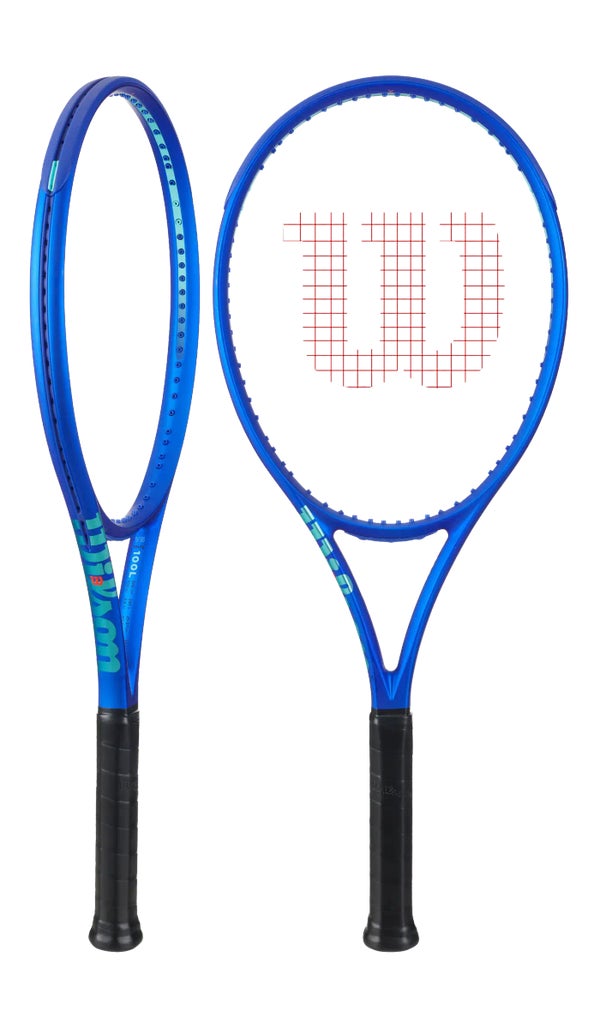
- Ultra 100L V5 Wilson280 g · 100 in² · 16x19See priceAmazon
The prices above are checked automatically at each store and may have changed since the last check. The price that counts is the one shown on the store's website at checkout. We may earn a commission on purchases made through store links, at no extra cost to you.